


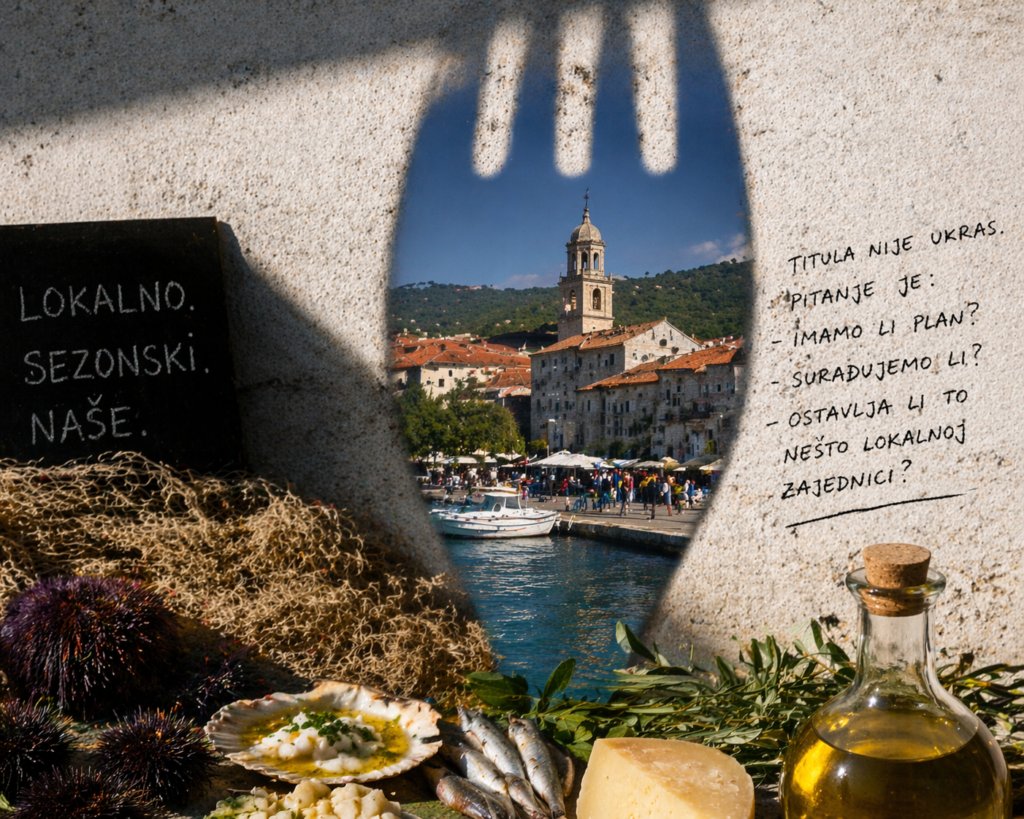
Kvarner has received the title of European Region of Gastronomy for 2026, but for Krk the real question is not how good that sounds in promotional texts, but whether the island can gain real benefits from it, a stronger pre season and post season, higher local spending and a more serious gastronomic identity that will not end up being only PR.
The title itself means almost nothing
Kvarner received this title from IGCAT, an organisation that focuses on local gastronomy, cultural heritage and sustainable tourism, and in their explanation for Kvarner they especially highlight cooperation, local identity and the development of year round tourism. All of this is nicely written and sounds serious in formal terms, but on its own it does not bring a better meal to the guest, higher income to the producer or a longer season to Krk.
That is why for Krk a more important question is whether this title will turn into something tangible or end up as just another year full of slogans, logos and formal phrases that look good at conferences but change very little in practice.
Krk does not have to invent its identity, it already has one
The biggest advantage of Krk is that it does not have to pretend to be a gastronomic destination, because it already is one. Official island websites have for years highlighted šurlice, lamb dishes, local sheep cheese, olive oil, figs and Vrbnik žlahtina as the core of Krk’s gastronomy. This means that the island already has recognisable products and dishes that are not invented for tourists, but are a real part of the local tradition.
In other words, Krk does not need a “new story”. It needs a more serious use of the existing one. When a destination already has local dishes, wine and products that are recognisable, the problem is less about identity and more about how well it can turn that into real value for the guest.
The strongest argument is not events, but products that already carry weight
When all promotional excess is removed, the strongest gastronomic argument of Krk is not events, but products that already have real weight beyond the island. Krk prosciutto is registered as a protected geographical indication at the European Union level, and Krk olive oil as a protected designation of origin. This is no longer a local story for internal use, but concrete proof that Krk has products capable of carrying a serious gastronomic identity.
This is important because it shows that Krk is not starting from zero. If the island already has EU protected prosciutto and EU protected olive oil, then there is no longer a reason to treat gastronomy as decoration alongside accommodation and beaches. In that case, gastronomy should be one of the main reasons for visiting, at least for some guests, especially outside the peak summer season.
The real benefit for Krk does not come from the title, but from spending
For Krk, this year will only make sense if it brings concrete changes. This means that guests on the island can more easily access truly local food, that producers gain greater visibility and better sales, that restaurants work more seriously with local ingredients, and that accommodation owners start using gastronomy as part of their offer, not just as a casual recommendation.
If this does not happen, then the title will remain just another nice frame around old practice, where everyone refers to local, but the guest often ends up with an offer that is too similar to that in half of the Mediterranean. This is exactly where Krk has a problem of execution, not a lack of content.
The most interesting part of the whole story is actually Krk Made
If one is looking for something on Krk that appears more concrete than the usual promotional story, then it is the project Krk Made - Sharing the Taste of the Island. The official call for participation clearly states that the goal is to connect restaurateurs and family farms into a joint island platform, promote authenticity and sustainability, and strengthen year round tourism. Restaurateurs are expected to base at least 30 percent of their menu on locally sourced ingredients and to offer at least three wines from Krk winemakers, with special emphasis on žlahtina.
That is already far more serious than an empty story. If such criteria are truly applied, then Krk is for the first time getting a model in which the local product, the local restaurant and the island’s overall promotion are not separate stories, but parts of the same system. That is precisely why the direction in which Krk Made is moving is more important than the Kvarner title itself. The title is a framework. Projects like this can be the actual content.
If there are also workshops that connect knowledge, ingredients and a new generation of chefs, then this is an even better sign, because gastronomy then stops being just a matter of promotion and becomes something that is truly passed on and built over the long term. This is exactly where the difference between a tourist decoration and real development becomes visible.
Krk can benefit the most outside July and August
The biggest opportunity for Krk is not to add another label to an already full summer season, but to turn gastronomy into a reason to visit in April, May, September and October. This is especially important for holiday homes and higher quality accommodation, as guests who come for food, wine, olive oil and local experiences are less dependent on sea temperature.
On the island there are already formats that show such a direction makes sense. An example are programmes that combine walking, local specialties and Kvarner wines, which is exactly the type of content that works better in the pre and post season than in the peak summer crowds. Such models may not sound spectacular, but for real destination development they are often more important than big slogans.
Krk does not need new slogans, but consistency
Krk already has all the key ingredients of a serious gastronomic story. It has traditional dishes. It has wine. It has prosciutto. It has olive oil. It has local producers. It has a recognisable identity that was not invented yesterday. What is often missing is consistency in truly placing all of this at the centre of the offer, rather than at its margins.
A guest who reads that Kvarner is a European gastronomic region does not expect another generic offer. They expect to feel the difference between Krk and another destination. They expect that what is called local is truly local. They expect that a konoba can explain what it serves. They expect that a holiday home can recommend a local olive mill, winery, family farm or a place where they will eat something genuinely from Krk. If that is missing, then the whole story remains weak.
Conclusion
Kvarner is the European Region of Gastronomy 2026, and that is a fact. But for Krk, the issue is not how good that title sounds, but whether it can be turned into a more serious local offer, greater visibility for producers and a stronger pre and post season. The island already has a very solid base for this, from šurlice and lamb to žlahtina, Krk prosciutto and Krk olive oil.
If 2026 is reduced only to phrases and protocol announcements, then not much will remain of it. But if the story turns into a series of concrete actions such as stronger connections between restaurants, producers, wines, local ingredients and projects like Krk Made, then Krk could truly make use of this year. And it is precisely here that the difference between real gastronomic policy and ordinary tourism marketing will become visible.

