Who is a non resident?
A non resident is a person who does not have a registered residence or habitual residence in Croatia, but owns property in Croatia or earns income from renting it out.
In practice, these are most often foreign owners of houses, villas and apartments on Krk who live in Germany, Austria, Slovenia, Italy, Czechia, Slovakia, Hungary or other countries, and who use the property for holidays and/or tourist rental.
It is important to know that the rules differ depending on whether the owner is a citizen of a member state of the European Union, the European Economic Area or Switzerland, or comes from a third country. This difference can be especially important when categorizing accommodation and choosing the legal model for renting.
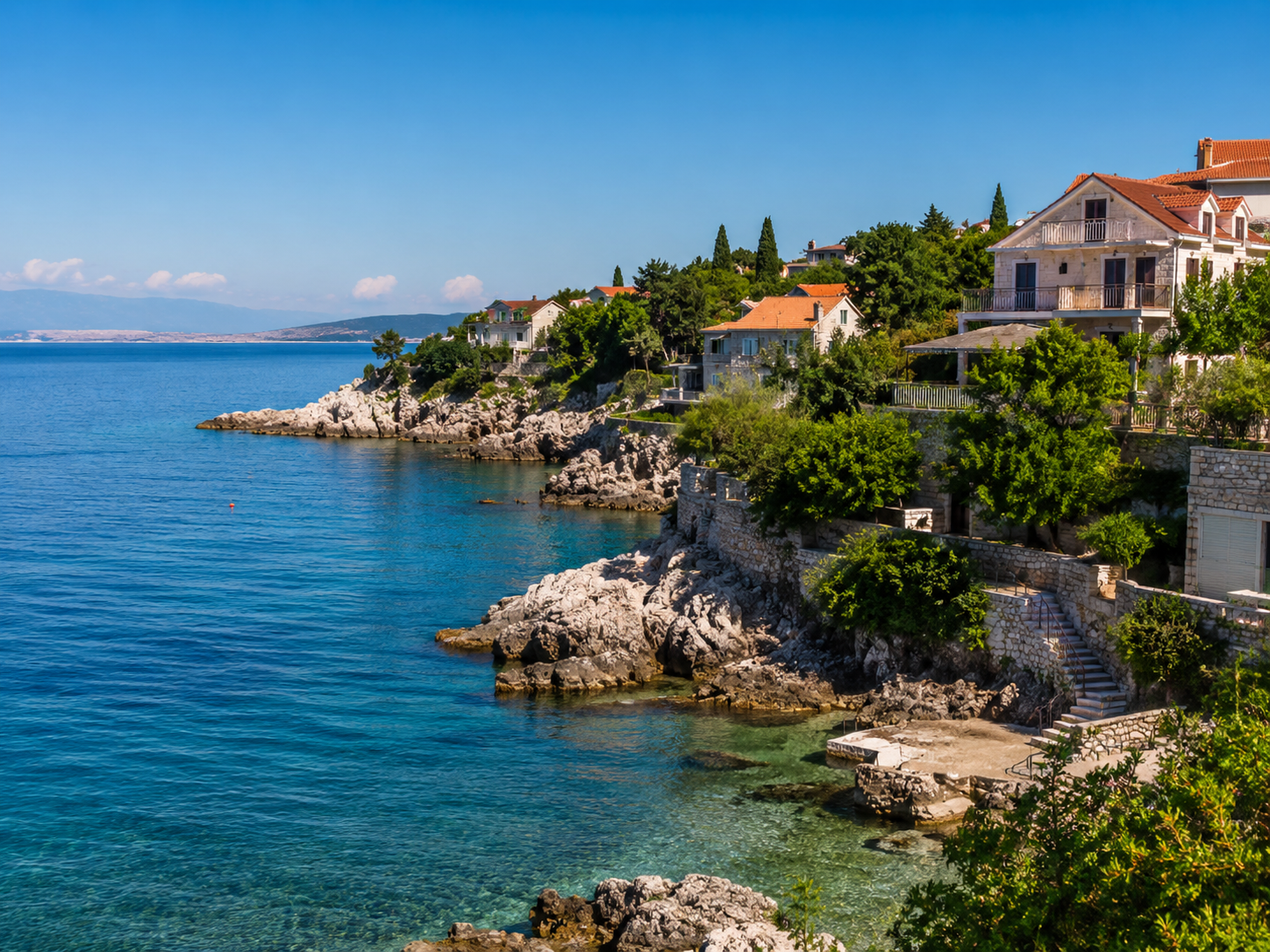
Accommodation categorization for non residents
Categorization is the first key step for legally renting accommodation. Without a categorization decision, you cannot legally provide tourist accommodation services, register guests in eVisitor or advertise the property as tourist accommodation.
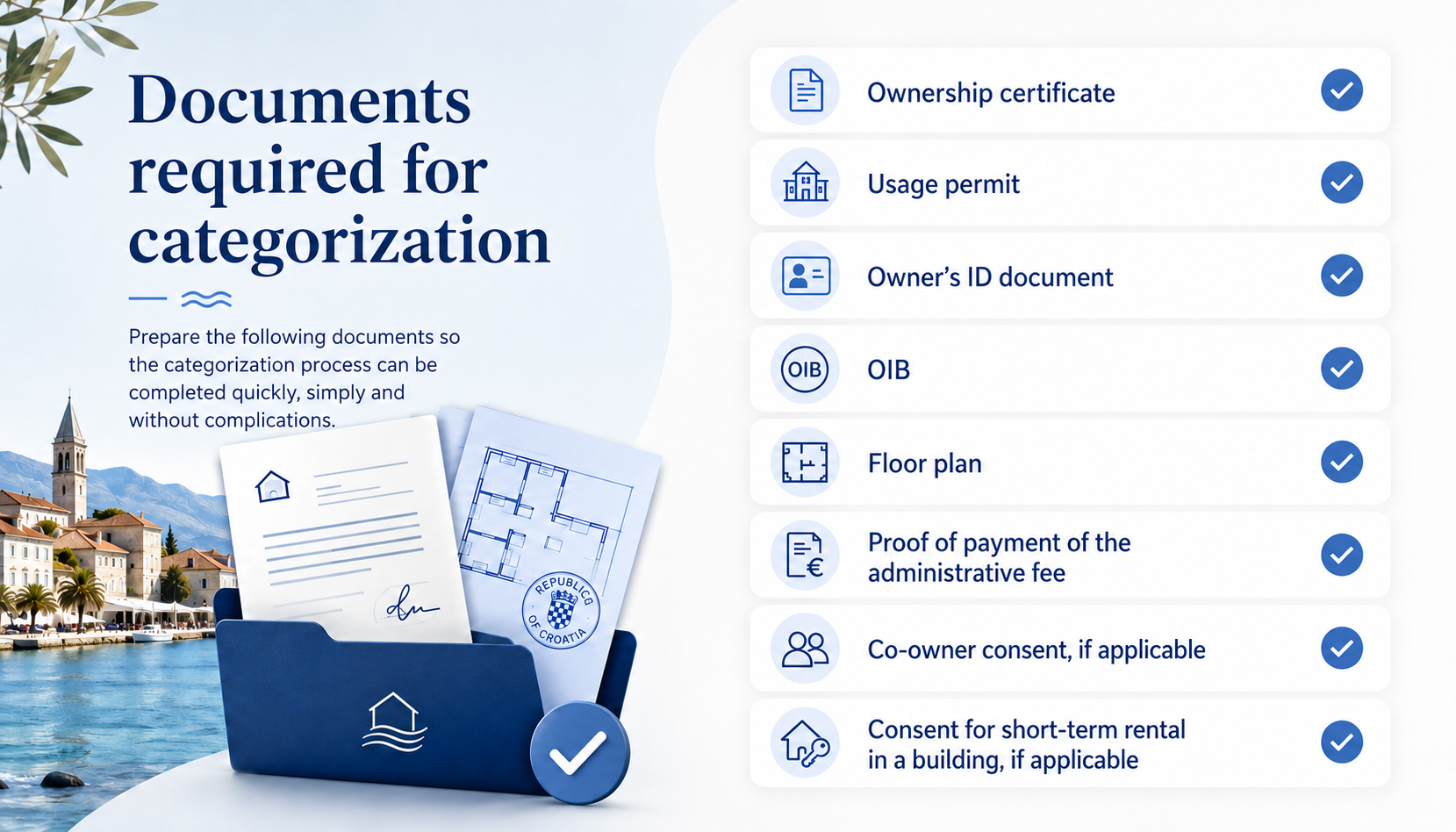
For holiday homes and apartments on Krk, the following are most often required:
- title deed,
- proof that the building is fit for use, most often an occupancy permit,
- the owner’s identity document,
- OIB,
- a graphic layout of the space with surface areas,
- proof of payment of the administrative fee,
- consents of co owners, if any,
- consent for short term rental if the property is located in a multi unit residential or mixed residential and commercial building,
- a properly equipped property according to the prescribed conditions.
Read the detailed guide on the conditions, forms and categorization procedure here:
Categorisation of Holiday Homes and Apartments
.
Important note for third country nationals
Important: If you are a citizen of a country outside the European Union, the European Economic Area and Switzerland, you should not automatically assume that you can categorize accommodation in your own name as a natural person in a household.
Under the new rules, third country nationals can no longer categorize accommodation in their own name as standard private accommodation providers. In such cases, it is usually necessary to consider another legal model, for example operating through a company or another appropriate entity in Croatia.
This is especially important before buying, building or investing in a property. The fact that someone can buy or build a house on Krk does not automatically mean that they can also categorize it in their own name for tourist rental.
Before investing, it is necessary to check the owner’s citizenship, ownership structure, property documentation, the possibility of categorization and the most favourable legal model for future rental.
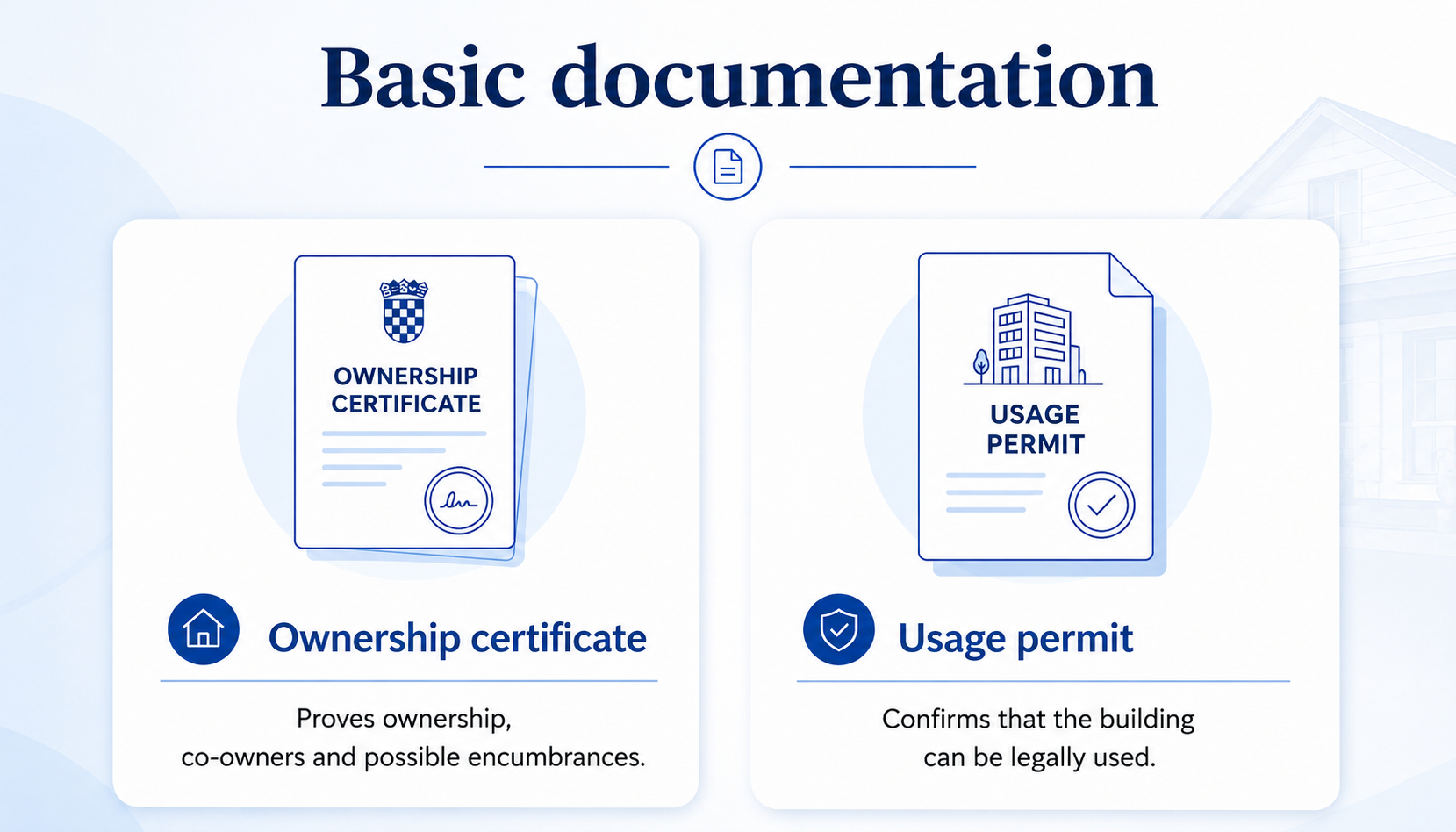
Basic documentation: title deed and occupancy permit
For non residents who are buying, building or already own a property on Krk, the two basic documents are the title deed and the occupancy permit, or another appropriate proof that the building is fit for use.
Title deed
The title deed shows who owns the property, whether there are co owners, encumbrances or other circumstances that may affect the categorization and rental procedure.
Occupancy permit
An occupancy permit or another proof that the building is fit for use confirms that the building may be used. If the property does not have the appropriate proof of usability, the categorization procedure may be stopped until the legality of the building is resolved.
Operating and taxation models for non residents
The tax model should be resolved before starting to advertise, receive payments and work with agencies or guests. For non residents, it is especially important to know who issues the invoice, who charges for the service, who calculates VAT and who keeps tax records in Croatia.
In practice, there are three basic operating models. Each model has its own advantages, limitations and administrative obligations, and the right choice depends on the owner’s country, sales method, expected turnover, type of property and whether the owner wants to operate independently or through a Croatian tourist agency.
Model 1
Classic model, taxpayer in Croatia
In this model, the non resident operates as a taxpayer in Croatia. This means they must have a clear tax status, keep the prescribed records, issue invoices, monitor turnover and calculate tax obligations.
If the conditions are met, the non resident may be required to enter the Croatian VAT system. This model is the most administratively demanding, but it may be necessary if the owner operates independently, rents directly to guests, uses foreign platforms or does not use an operating model through a Croatian agency.
Model 2
Working through a Croatian tourist agency
The second model is cooperation with a
Croatian tourist agency on Krk
that takes over the tax liability and pays VAT instead of the non resident, depending on the agreed business model.
For a large number of non residents, this is the simplest solution because sales, payments, invoice issuing and tax administration are handled through a Croatian entity. This reduces the risk of incorrect calculation, incomplete records and unclear tax treatment.
Model 3
EX number from 1 January 2025
From 1 January 2025, it is also possible to operate through an EX number. If the non resident meets the conditions and operates through a Croatian agency, they do not have to enter the VAT system in Croatia.
This model may be especially interesting for smaller accommodation providers who want a simpler way of operating, but before starting business it is necessary to check the conditions, the owner’s country, expected turnover, tax status in the home country and the way the accommodation will be sold.
How to choose the right model?
If a non resident wants to sell accommodation independently, receive payments and work directly with guests or foreign platforms, the classic model may be necessary. If they want simpler operations and less administration, working through a Croatian tourist agency is often the safer choice. If they meet the conditions for an EX number from 2025, it is possible to avoid entering the Croatian VAT system, but this model should be checked before starting operations.
The biggest mistake is to start taking reservations without a clearly defined tax model. For non residents, tax obligations must not be resolved afterwards, because the way sales and invoice issuing are set up from the beginning affects the entire business system.
Not sure which model applies to you?
Send us an inquiry and include the owner’s country, property type, location on Krk and planned rental model. Based on that, we can guide you towards the model that makes the most sense for your situation.
Send an inquiry
Tourist Tax and eVisitor
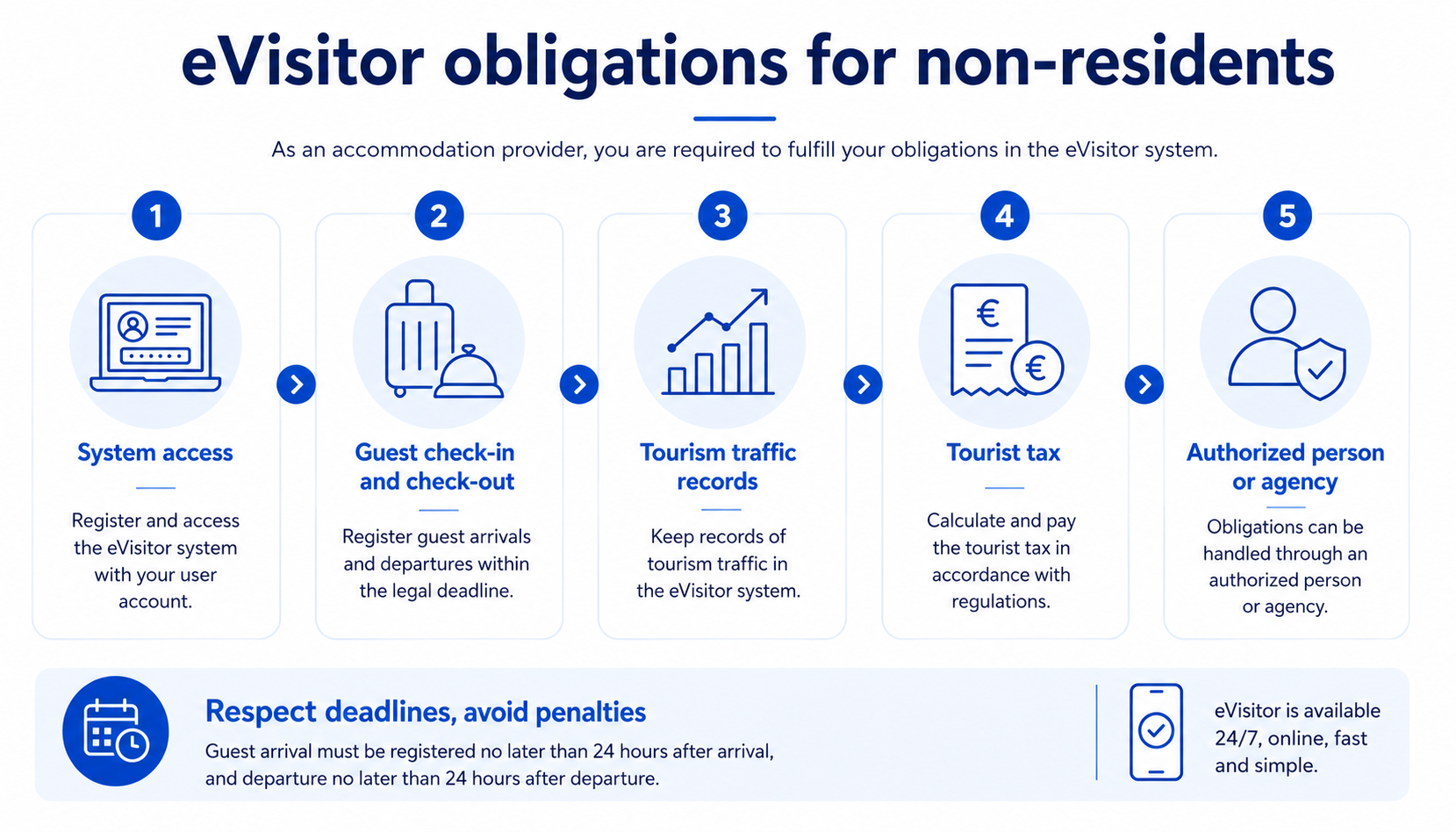
All accommodation providers must have access to the eVisitor system arranged and must properly register guests. eVisitor is used for guest check in and check out, records of tourist traffic and the calculation of tourist tax.
For non residents, it is especially important to know in advance who handles registrations, who monitors arrivals and departures, who communicates with the tourist board and who is responsible if a problem occurs.
In practice, for non residents, a local person, agency or professional entity is most often authorized to handle the operational part of the work.
Banking, administrative and accounting requirements
A non resident who wants to legally rent accommodation on Krk needs to have a proper administrative structure in place. It is especially important to know before starting operations who receives payments, who issues invoices, who keeps records and who communicates with tax and tourism authorities.
Most often, the following need to be arranged:
- OIB,
- tax status,
- invoice issuing model,
- bank account or a clearly defined payment method,
- agency contract if working through an agency,
- access or authorization for eVisitor,
- accounting if the model requires it,
- turnover records,
- tourist board membership fee and other obligations if they apply.
For non residents, it is especially important that payments, invoices and contracts are not handled informally. If working through an agency, the contract should clearly define the sales price, commission, invoice issuing method, payment collection and the obligations of each party.
Remote property management
For non residents, the biggest challenge is often not only tax, but everyday logistics. The property must be prepared before the season, maintained during the season and checked after each guest departure.
This includes:
- cleaning,
- washing and changing bed linen,
- pool maintenance,
- garden maintenance,
- checking air conditioning units, boilers, locks and internet,
- key handover or organization of self check in,
- communication with guests,
- emergency interventions,
- damage control,
- regular supply of consumables,
- final inspection of the property after the season.
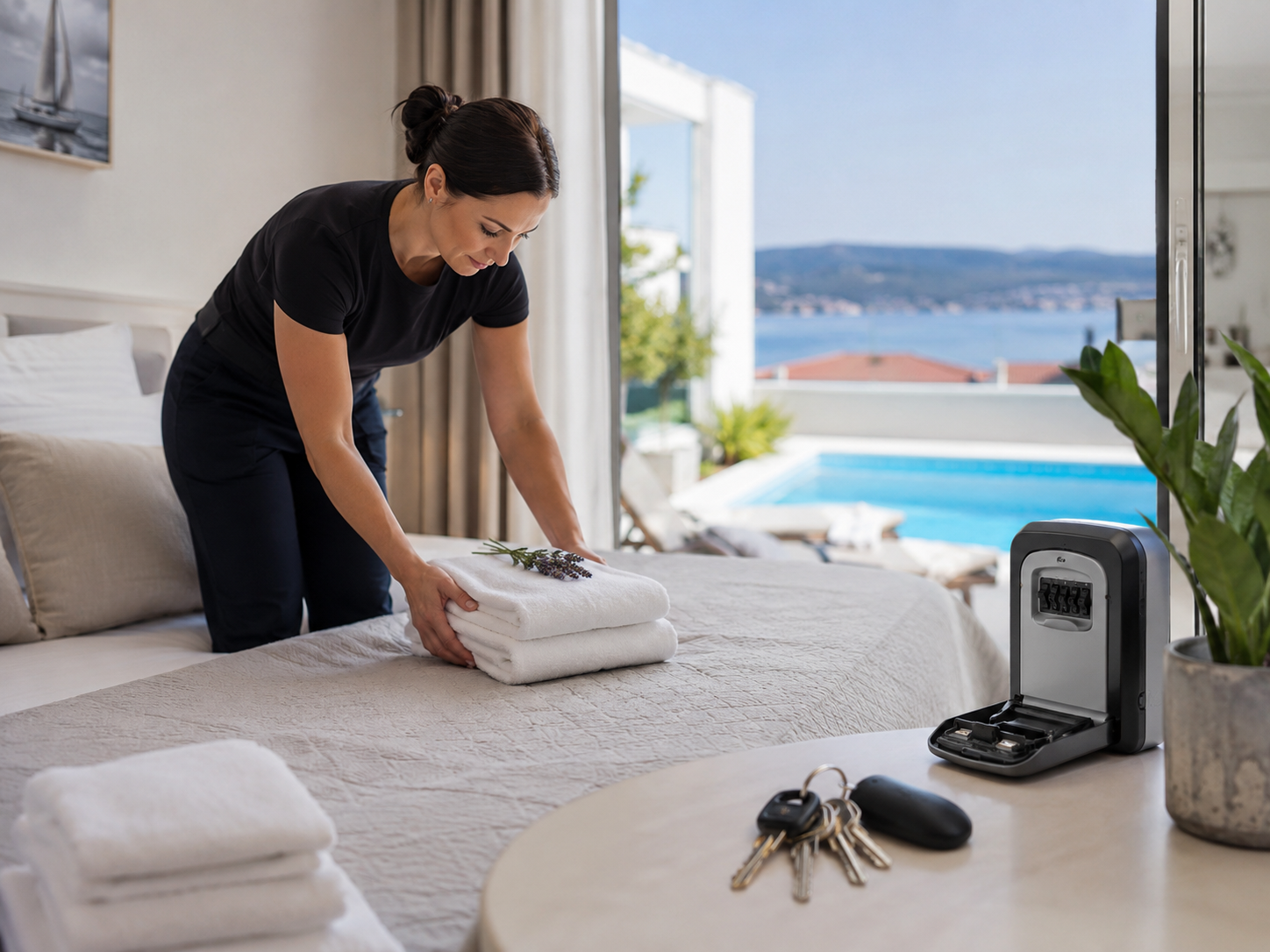
If the owner is not on Krk, they must have a person or entity who can react quickly. The guest expects a solution immediately, regardless of whether the owner is in Croatia, Germany, Austria, Slovenia or another country.
Most common mistakes made by non residents
Buying or building without checking the possibility of categorization
A property may look ready for tourism, but if it does not have an occupancy permit or another proof that the building is fit for use, categorization may get stuck.
Assuming that all foreign owners can rent in the same way
It is not the same whether the owner is a citizen of the EU/EEA or a third country. For third countries, it is especially important to check whether the accommodation can be categorized in the name of a natural person at all.
Wrong tax model
Non residents often start advertising first and only later check VAT, the EX number, the agency model or accounting. This can create unnecessary tax and administrative problems.
Unclear agreements with an agency or person on site
If it is not clear who registers guests, who issues invoices, who collects payments, who maintains the property and who reacts to breakdowns, a problem will appear already with the first more demanding situation.
Poor property preparation
A good location is not enough. The property must be technically ready, clean, functional and maintained. This especially applies to villas, pools and higher standard holiday homes.
Recommendations for non residents
If you are a non resident and own a property on Krk, the most important thing is to set up the rental system correctly from the beginning.
The best solution is to have a reliable person,
an agency for private accommodation providers on Krk
or a professional entity that can take over the coordination of all key matters:
- checking documentation,
- assistance with categorization,
- choosing the tax model,
- communication with the accountant,
- cooperation with the tourist board,
- eVisitor,
- cleaning,
- maintenance,
- communication with guests,
- emergency interventions,
- property inspection.
For owners who do not live on Krk, this kind of support is not an additional luxury, but the foundation of safe and long term renting.
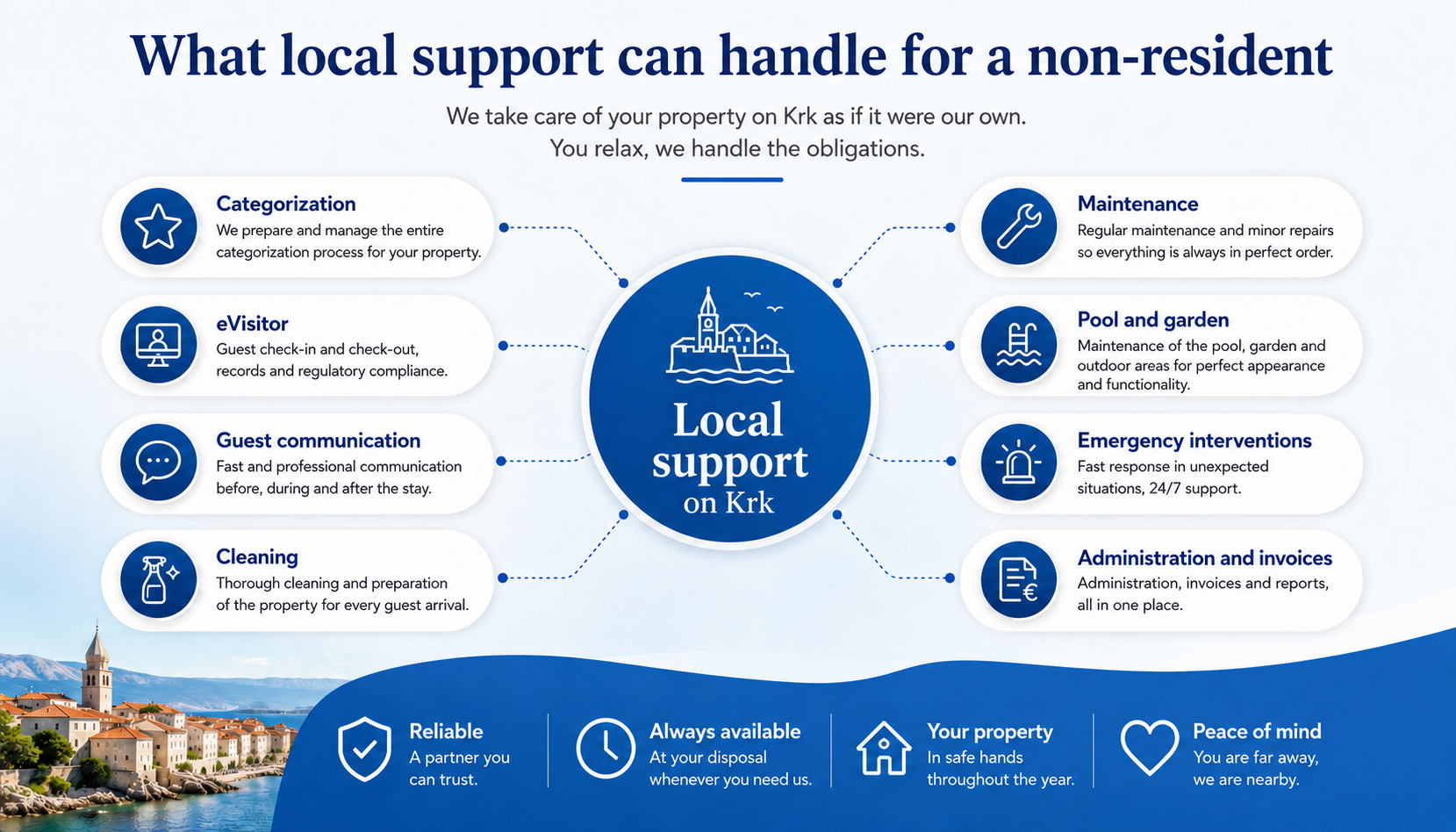
Need help with renting as a non resident?
If you are a non resident and want to rent out a house, villa or apartment on Krk, it is important to check the documentation, categorization, tax obligations and organization of work on site before you start.
More information and an inquiry can be sent via the contact page.
Contact us
Frequently asked questions
Can non residents rent accommodation on Krk?
Yes, but it depends on citizenship, ownership structure, property documentation and the tax model. Citizens of the EU/EEA and Switzerland have a different status from third country nationals.
Can third country nationals categorize accommodation in their own name?
Under the new rules, third country nationals can no longer categorize accommodation in their own name as standard private accommodation providers. As a rule, a business entity or another appropriate legal model should be considered.
What is most important for categorization?
The most important thing is to have a proper title deed and proof that the building is fit for use, most often an occupancy permit. In addition, forms, sketches, surface area data and other documentation are prepared according to the type of property.
Does a non resident have to pay VAT in Croatia?
It depends on the operating model. Different models are possible: entering the Croatian VAT system, working through a Croatian tourist agency or using an EX number if the conditions are met.
What is an EX number?
An EX number is connected to a special operating model for non residents from 1 January 2025. If the conditions are met, a non resident can operate without entering the Croatian VAT system, especially when working through a Croatian agency.
Does a non resident need to use eVisitor?
Yes. All guests must be registered and checked out through eVisitor. A non resident can authorize a local person, agency or professional entity to handle this on their behalf.
Is it better to work independently or through an agency?
For non residents, it is often safer to work through a reliable Croatian agency or local partner, especially if the owner does not live on Krk and cannot handle guests, registrations, cleaning, maintenance and emergencies on a daily basis.