


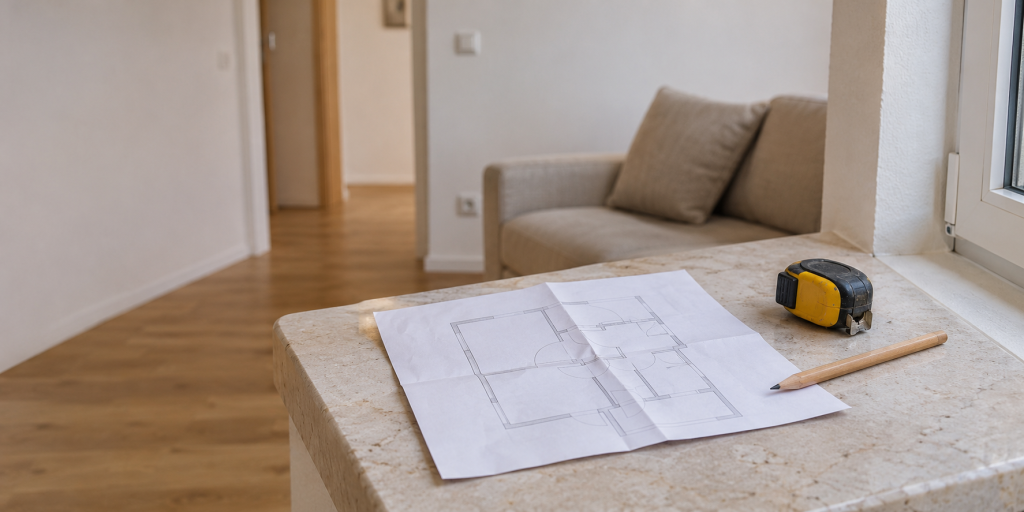
This guide is for first-time applicants: you are building, buying or renovating a holiday home or apartment on Krk and want to know what needs to be in order before you submit your application.
The forms, Annex II and the contact details of the office in Krk are not here but in our guide Categorisation of apartments and holiday homes on Krk: requirements, forms and contacts. Here you will find the questions that come before the form: can the building be categorised at all, is it a "new" or an "existing" property, who the licence is issued to, what it costs and what changes under the new Hospitality and Catering Industry Act.
Building documentsAn occupancy permit or a document that replaces it. Without it there is no licence.
New or existingThe year of construction decides which minimum floor areas apply to your property.
Who it is issued toOwner, co-owners, family, company or trade, citizenship.
Units and bedsMeasure the net floor areas before you decide on the number of beds and the category.
Apartment buildingsA flat in a building needs the written consent of the co-owners before you apply.
1. Does the building have proof of usability
This is the first question, before floor areas, stars and furnishings. The Hospitality and Catering Industry Act (Art. 34(2)) requires the building to meet the conditions of the building regulations without which a licence cannot be issued, and the new Building Act (Official Gazette 155/25, in force since 1 January 2026) states in Art. 94 that a completed building may only be used, and a licence for a business activity in it may only be issued, after the building authority has issued an occupancy permit (uporabna dozvola).
The occupancy permit is not the only document that is recognised. Under Art. 131 of the new Building Act, the following are also treated as an occupancy permit:
- occupancy permits issued under the previous Building Act, including those for buildings constructed before 15 February 1968 and before 19 June 1991,
- a decision on the as-built state (rješenje o izvedenom stanju) from the legalisation procedure and the as-built certificate,
- a final building permit or other equivalent document issued before 19 June 1991 together with confirmation from the building inspectorate that no proceedings are pending,
- a certificate that the building was constructed or recorded before 15 February 1968,
- confirmation from the administrative body that the supervising engineer's final report has been submitted.
The County forms 17 and 12 still ask for "proof of usability of the building under Art. 175 of the Building Act". That is the numbering of the old act; the substance is unchanged and the list of recognised documents is now in Art. 131. If you hold any of the documents listed above, you have proof of usability.
What if there is no proof? The categorisation procedure cannot be completed until the status of the building is resolved with the building authority. Temporary licences for buildings in the legalisation procedure are not available as a new option: under the draft of the new Hospitality and Catering Industry Act (Art. 88), only those who already hold a temporary licence on the day the act enters into force may continue to operate on it, and no later than 31 December 2030.
Practical advice when buying: ask for the occupancy permit or one of the substitute documents before you sign the preliminary contract, not after. If the seller does not have one, ask why. An extra floor or a glazed terrace built without a permit is not a cosmetic issue but a reason for the categorisation application to be rejected.
2. New or existing property: why it decides the floor areas
The Ordinance on the classification and categorisation of facilities providing hospitality services in households (Official Gazette 9/16, 54/16, 61/16, 69/17 and 120/19) distinguishes in Art. 4 between existing and new properties. A property is existing if it meets one of three conditions:
- it has or had a licence for type and category as an existing property,
- the building was constructed before 31 December 2007, regardless of its use or any later reconstruction, extension or addition of floors,
- the property has a legalisation document for an illegally constructed building.
Everything else is a new property. In practice: a house from 1995 that you renovated in 2025 remains an existing property. A house built in 2019 is a new property. A legalised house, whatever its year, counts as existing.
The difference is not a formality. Annex II of the Ordinance (version from Official Gazette 54/16) sets separate minimum floor areas per unit for existing and for new properties in every category, and a unit in a new property must also have an entrance hall. Example for a holiday home, range from the lowest (two stars) to the highest category (five stars):
| Holiday home unit | Existing property | New property |
|---|---|---|
| one bedroom | 28.5 to 48 m2 | 36 to 51 m2 |
| two bedrooms | 38.5 to 71.5 m2 | 51 to 79 m2 |
| three bedrooms | 50.5 to 91.5 m2 | 63 to 106 m2 |
| each further bedroom with bathroom | 13 to 20 m2 | 15 to 24 m2 |
For an apartment the figures are lower (one-bedroom unit: existing 25.5 to 45 m2, new 33 to 48 m2), and staircases do not count towards the floor area of the unit. Check the exact values for your category and number of bathrooms in Annex II; the link is in the sources at the bottom.
Beds follow the floor area, not the other way round. Under Art. 11 of the Ordinance, each bedroom of an apartment or holiday home may have one, two or three beds, with the unit having to be 3 m2 larger for the third bed. The living room may have two extra beds if there are none in the bedrooms, and extra beds do not count towards capacity but are only listed in the licence. Anyone designing a new house with letting in mind should show these figures to the architect before the walls are drawn.
3. Who the licence is issued to
The licence is issued to a person, not to a house. Under Art. 34 of the Hospitality and Catering Industry Act the applicant must be the owner of the property. If there are co-owners, the County also requires their consent. The exception is family: a host may also provide services in a property owned by their spouse or common-law partner, life partner, relative in the direct line or family member, with that person's written consent. The draft of the new act (Art. 35(3)) narrows this exception to spouses, common-law partners, life partners and parents. If you plan for the licence to be issued to, say, your son or brother while you are the owner, that is a question to resolve before the act enters into force.
The second question is who you are: a private individual, a company or a trade, and which citizenship you hold.
Natural person (private individual). A citizen of Croatia or another EEA country or Switzerland. Up to 10 rooms or 20 beds, extra beds not counted. Form 17, fee 9.29 EUR. Taxation is usually the flat-rate tax per bed.
Hospitality business. Licence on compliance with the conditions for type and category, Form 12, fee 18.58 EUR, more extensive documentation (register extract, certificates, and for buildings over 400 m2 gross a fire protection opinion). No 20-bed limit, but no flat-rate tax either.
It depends on citizenship, not on your address. Citizens of the EU, the EEA and Switzerland can be private hosts (household). Citizens of third countries do not fall within the legal definition of a host and therefore usually go through a company or trade. Details are in our guide Holiday letting for non-residents.
A flat in an apartment building. The Building Management and Maintenance Act (Official Gazette 152/24, Art. 34) requires the prior written consent of a two-thirds majority of co-owners and, in addition, the consent of all co-owners whose walls, floors or ceilings adjoin your flat. The consent is given for a period of at least five years. The County requires the building manager's decision on that consent as an attachment to the application, for households and companies alike. The draft of the new Hospitality and Catering Industry Act goes a step further: companies and trades would no longer receive new licences for rooms and apartments in multi-family and mixed-use buildings (Art. 21(2)), and existing licences of that kind would have to be brought into line within ten years (Art. 86). Holiday homes are not affected.
4. What it costs and how long it takes
The procedure itself is cheap. The administrative fee for a household licence is 9.29 EUR (Regulation on the Tariff of Administrative Fees, Official Gazette 156/22, tariff no. 14 item 3.a; the same amount is stated on County Form 17). For companies and trades the fee for a room, apartment, studio apartment or holiday home is 18.58 EUR (tariff no. 14 item 2.c, Form 12). It is paid into the state budget; the payment details are on the forms. The old ordinance provided that the host also bears the costs of the inspection committee (daily allowances, travel), but that provision was deleted in 2017 (Official Gazette 69/17).
The real cost is what comes before the application: the occupancy permit or legalisation if they are missing, an architect for the floor plan with areas, the prescribed plaque with the type and category that you order from an authorised manufacturer after the licence is issued, and the furnishings required by Annex II for the category you are aiming for.
As for timing, the General Administrative Procedure Act (Art. 101) gives the official 30 days to issue a decision without an examination procedure, or 60 days when an examination procedure is conducted, counted from a complete application. Categorisation includes an on-site inspection by the committee, so the realistic timeframe is the second one. The deadline runs from a complete application: if the building manager's consent is missing or the floor plan has no areas, the clock does not start. Art. 28 of the Ordinance states expressly that the application is submitted when the property is ready to receive guests. Submit it when the beds, kitchen and bathroom are finished, not when "the furniture is still on its way". If you are aiming for the summer season, applying in spring is late; the winter months are when the office has fewer cases.
5. What the new Hospitality and Catering Industry Act brings
Status as at 3 November 2026: The final draft of the Act (P.Z.E. no. 315) was sent to Parliament on 21 October 2026 and is on the agenda of the session starting on 10 November 2026. The Act has not yet been passed. Below are the provisions of the final draft; we will update this article once the Act is published in the Official Gazette.
For someone just entering categorisation, the draft changes five things:
- Re-categorisation every ten years. The competent authority will, on its own initiative, re-examine compliance with the conditions for type and category (Art. 38). If the property no longer meets the conditions, a lower category is set or the licence is revoked, and the host then bears the costs.
- New licences for all existing hosts. Anyone operating on a household licence on the day the Act enters into force must obtain a new licence: within five years of the new ordinance entering into force if the licence was issued before 31 December 2015, or ten years if it was issued from 1 January 2016 (Art. 80). The ten-year period until the next re-categorisation runs from that new licence.
- A one-year wait after deregistration. Anyone who deregisters can obtain a new licence for the same property only after one year has passed since the revocation (Art. 35(4)). Deregistering "for the winter" to avoid the flat-rate tax thus becomes an expensive decision.
- Registration number from 1 May 2027 To advertise on platforms you will need a registration number issued through the eTurizam system, with a copy of the household licence (Art. 46). The categorisation licence is a prerequisite, so it is worth having it before that date. Details are in our article Croatia: Registration Number for Holiday Rentals From May 2027
- Companies and trades in residential buildings will no longer receive licences for rooms and apartments; holiday homes remain possible (Art. 21(2)).
The draft also introduces the status of "domaćin" (resident host) (Art. 30): a host whose registered residence is in the county where the property is located, unless they let in a multi-family building. Which tax advantages a resident host will have is governed by other regulations, so we will cover that separately. The Act would enter into force on 1 January 2027, and until the new ordinance is adopted the existing Ordinance with Annex II remains in force (Art. 89).
6. The most common mistakes with new properties
- Buying without checking the proof of usability. The buyer sees a lovely house and a land register extract, and only after the purchase learns that a floor was added without a permit. The land register extract proves ownership, not the legality of the building.
- Number of beds set by the listing, not by the floor area. "6+2" sells well on the platforms, but the licence sets the capacity according to the units in Annex II. The committee measures; the difference ends up as a lower category or fewer beds than you have already sold.
- A new property designed to the dimensions for an existing one. A house built after 2007 must have an entrance hall and larger units. If that is not known at the design stage, it cannot be fixed later without knocking down walls.
- A flat in a building without the co-owners' consent. The application is returned, and the neighbours' consent cannot be forced. Ask the neighbours before buying a flat to let, not after.
- Advertising before the licence. A listing on a platform, taking bookings and registering guests before the licence is issued are not "preparing for the season" but the unregistered provision of services. What that looks like in an inspection is described in our article on the tourist inspection.
- A licence in a family member's name "for the time being". If the licence is in a parent's name and you will inherit the house, under the draft of the new act the heir may continue under the same licence, but only once without a fresh examination of the conditions (Art. 37). Think ahead about whose name the licence should be in over the long term.
Ready to apply?
Once the building documents, floor areas and the applicant are clear, the next step is the County forms, Annex II and the contact details of the office in Krk. All of that, together with the most frequent questions about the procedure itself, is in our main guide.
Categorisation: conditions, forms and contactsFrequently asked questions
Can a house be categorised without an occupancy permit?
Yes, if there is a document that is treated as an occupancy permit under Art. 131 of the Building Act (Official Gazette 155/25): a decision on the as-built state from legalisation, a building permit issued before 19 June 1991 with confirmation from the building inspectorate, a certificate that the building was constructed before 15 February 1968 and the like. Without any such document the procedure cannot be completed.
Who should the categorisation licence be issued to?
To the owner of the property who is a citizen of Croatia, another EEA country or Switzerland, or to a company or trade that has the right to use the property. Exceptionally it may be issued to the owner's spouse or common-law partner, life partner, relative in the direct line or family member with written consent; the draft of the new act narrows this exception to spouses, partners and parents.
What documents are needed to categorise a holiday home?
For a household (Form 17): a copy of your identity card, a land register extract no older than six months with the co-owners' consent if there are any, proof of usability of the building, for a flat in a building the building manager's decision on the co-owners' consent, a floor plan of the property with areas (may be hand-drawn) and proof of payment of the 9.29 EUR fee. Links to the forms are in our main guide.
How much does categorising an apartment cost?
The administrative fee is 9.29 EUR for a household and 18.58 EUR for companies and trades. Other costs (the plaque, the floor plan, furnishings under Annex II) depend on the property.
How long does the categorisation procedure take?
The General Administrative Procedure Act sets a deadline of 30 or 60 days from a complete application. In practice it depends on how complete the documentation is and how long the committee takes to carry out the inspection. The application is submitted when the property is ready for guests.
What is re-categorisation and when is it mandatory?
Re-categorisation is a fresh determination of the type and category of the same property. You request it yourself when you want more or fewer stars or when the property has changed. Under the draft of the new Hospitality and Catering Industry Act the competent authority will carry it out on its own initiative every ten years, and all existing hosts will have to obtain a new licence within five or ten years, depending on whether their licence was issued before or from 2016.
Which form does a company use?
County Form 12, the application for the classification and categorisation of accommodation facilities, with a fee of 18.58 EUR. It is accompanied by the court register extract, proof of the right to use the premises, proof of usability, a floor plan with areas and certificates.
Sources
- Croatian Parliament: Final draft of the Hospitality and Catering Industry Act, second reading, P.Z.E. no. 315 (21 October 2026)
- Hospitality and Catering Industry Act (Official Gazette 85/15 to 152/24), consolidated text
- Building Act (Official Gazette 155/25), Art. 94 and 131
- Ordinance on the classification and categorisation of facilities in households (Official Gazette 9/16), Art. 4, 11 and 28
- Annex II in the current version (Official Gazette 54/16), conditions for the categories of apartments and holiday homes
- Regulation on the Tariff of Administrative Fees (Official Gazette 156/22), tariff no. 14
- Building Management and Maintenance Act (Official Gazette 152/24), Art. 34
- General Administrative Procedure Act (Official Gazette 47/09, 110/21), Art. 101
- Primorje-Gorski Kotar County, Administrative Department for Tourism, Entrepreneurship and Rural Development: forms 17 and 12