


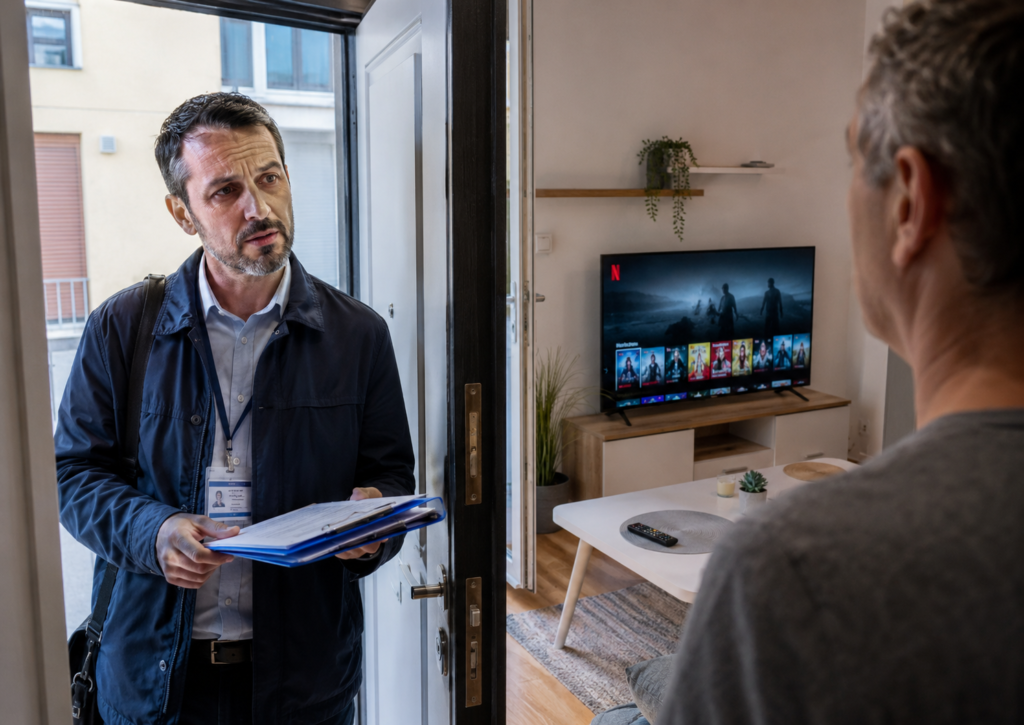
The HRT licence fee has been one of the most disliked obligations in Croatia for years. People still call it a subscription, although officially it is a monthly fee. The problem is not only the amount, but the feeling that the public broadcaster must be paid for, regardless of whether you watch it or not. Additional anger is caused by the perception among a large part of the public that HRT often does not act as a truly independent public broadcaster, even though the HRT Act explicitly states that HRT must not be under political influence or represent the interests of any particular political party.
On Krk and along the rest of the coast, this topic has another very concrete dimension: private accommodation providers. Almost every house, apartment or holiday home has at least one television. And where there is a television, there is HRT. Where there is HRT, there are bills, reminders, inspectors, arguments at the doorstep and the question that keeps coming up: does a separate fee have to be paid for every television in an apartment?
The answer is not quite the same as what is often heard in comments. It is not true that an HRT inspector can simply enter an apartment. It is also not true that a household subscription always covers televisions in apartments. And it is not true that HRT cannot rely on a listing, photograph or accommodation description on the internet.
What is the HRT licence fee and who has to pay it?
The Croatian Radiotelevision Act stipulates that anyone in Croatia who owns or possesses a radio or television receiver, or another device for receiving radio or audiovisual programmes, must pay a monthly fee to HRT if they are located in an area covered by a broadcasting signal. So, the law does not refer only to a classic television set, but more broadly: a receiver can also be another device that receives audio or audiovisual programmes.
On its official website, HRT states that the monthly fee amounts to 10.62 euros. The same page states that this amount has not changed since 2012.
For ordinary households, the rule is simpler: if a household has two or more receivers, it pays one monthly fee as if it had one receiver. HRT further explains that for one monthly fee, within the same household, an unlimited number of devices for receiving audio or audiovisual signals may be used, including a television, radio, computer, laptop or smartphone.
But an apartment is not always the same as a household.
A household is not the same as a tourist apartment
This is where the problem begins for accommodation providers. The HRT Act specifically states that legal entities, trades and other natural persons carrying out an independent activity pay the monthly fee for each receiver, unless otherwise prescribed by law.
Private accommodation providers are not hotels, but they are also not just an “ordinary household” when the television is used in an apartment that is rented to guests. The Hospitality and Catering Industry Act states that hospitality services in a household may be provided by a natural person, that is, an accommodation provider, and among these services it explicitly lists accommodation in a room, apartment and holiday home.
In other words: a television in a family living room and a television in an apartment advertised to tourists are not the same thing. One belongs to a household, the other is part of the tourism offer.
That is the key difference many people realize too late, usually only when a reminder arrives or when an HRT inspector appears at the door.
The most important rule for accommodation providers: one paid receiver plus three additional ones
This brings us to the part that is most often not clearly explained to accommodation providers.
The HRT Act contains a special exception for legal and natural persons carrying out hospitality activity. By paying the monthly fee for one receiver in a hospitality facility, they acquire the right to use three additional receivers in the same hospitality facility without paying an additional monthly fee.
In plain language: it is not entirely accurate to say that “three televisions are included in one subscription”. It is more accurate to say: one paid receiver plus three additional ones in the same hospitality facility. So, up to four receivers in total under one fee, but with one important limitation: they must be in the same hospitality facility.
This is where most disputes arise. Is a house with several apartments one hospitality facility? Is each apartment a separate facility? What if the categorization decision lists several accommodation units at the same address? What if one television is in an apartment, another in a room, a third in a common area and a fourth in another apartment?
This is not a topic for arguing with the person at the door. It should be resolved in writing: according to the categorization decision, the number of receivers, the address of the facility and an official response from HRT.
What must a private accommodation provider report?
An accommodation provider must report receivers used in the tourism activity. In practice, this means televisions, radio receivers, Smart TV devices and other devices for receiving audio or audiovisual programmes that are part of the offer of an apartment, room or holiday home.
The law stipulates that a person who has a receiver and is not a member of a household that already pays the fee must report the receiver to HRT no later than 30 days from acquisition, and must report a change of address, place of residence or registered office no later than 15 days from the change.
HRT has a special receiver registration form for legal entities, trades, business and other activities. The form requests information about the payer, OIB, owner or responsible person, contact details, the address at which the receiver is being registered, type of payer, main activity, type of receiver and number of units. The listed receiver types include TV, radio receiver, receiver in a vehicle and other AV devices.
This is also important: on its official inquiry page, HRT specifically lists a contact for “legal entities, trades and apartments”, pristojba.gospodarstvo@hrt.hr. This means that, in HRT’s communication, apartments are treated through the business channel, not as an ordinary household subscription.
The smartest approach is to have everything in writing: the number of registered televisions, the property address, the categorization decision and HRT’s confirmation of how much is payable on that basis. A verbal conversation with an inspector means almost nothing tomorrow.
What if there is no antenna and the TV is used only for Netflix?
This is perhaps the most important practical question today. Many apartments no longer have a classic antenna, terrestrial channels or cable television. There is a Smart TV in the accommodation, guests connect to Netflix, YouTube, Disney+, MAX or one of their own apps, and the owner logically asks: why should I pay HRT if HRT is not watched at all?
The problem is that the law does not link the obligation to watching HRT, or even exclusively to having an antenna. The law refers to a radio or television receiver, or another device for receiving radio or audiovisual programmes.
That is why an ordinary television, including a Smart TV without a connected antenna, is generally still treated by HRT as a television receiver. If it is in the apartment, if it appears in listing photos and if it is offered to guests as part of the accommodation equipment, it is difficult to defend the claim that “it is not a TV, but only a screen for Netflix”.
Technically, the accommodation provider can say that there is no antenna, no cable and that no linear TV programme is watched. But that is not the same as proof that there is no receiver. Especially if it is a Smart TV with built in apps, internet access and the ability to watch audiovisual content.
HRT itself interprets devices for receiving audio and audiovisual signals very broadly. On its official website, it states that households may have an unlimited number of such devices for one fee, regardless of whether they are televisions, radios, computers, laptops or smartphones.
For accommodation providers, this means the following: Netflix is not automatically a way out of the HRT licence fee. If you have a TV in the apartment, especially a Smart TV, HRT will treat it as a receiver. If you want to avoid that obligation, then you should not have a television in the apartment, nor advertise it as part of the accommodation amenities.
The situation is different if there is truly no television in the apartment, but only an ordinary monitor without a TV tuner, without an antenna, without a cable connection and without being advertised as a “TV”. That is a better position for the owner, but even then you should not improvise. If the device looks like a television, if the listing mentions a TV or if a Smart TV is visible in the photo, HRT will probably rely on that.
The simplest rule is this: if you have a TV in the apartment, report it. If you do not have one, do not include it in the description or in the photos. If you offer only a monitor for connecting a laptop or streaming device, do not call it a television in the listing.
Can an HRT fee collector enter an apartment?
Briefly: not without permission.
An HRT inspector may come to the address, ring the doorbell, introduce themselves and ask for information. They may ask whether there is a receiver. They may draw up a report on what they established or what they claim to have established. But they are not the police, not a court and not a tourist inspector.
The Constitution of the Republic of Croatia stipulates that the home is inviolable and that only a court may order a search of a home or other premises by a reasoned written warrant based on law. The Constitution also provides for exceptions for entry without a warrant, but these apply to law enforcement authorities in situations such as executing an arrest warrant, apprehending the perpetrator of a criminal offence or removing serious danger. An HRT inspector does not fall into that category.
This also applies to an apartment. If the apartment is rented to a guest, it is a space where the guest is staying and has the right to privacy. If the apartment is empty, the owner still does not have to let the inspector inside. They may let them in if they want to, but they do not have to.
In other words: HRT cannot “barge into” your apartment, open doors, walk through rooms, photograph televisions or enter a holiday home without the permission of the person who has control over that space.
Can a fee collector enter the yard?
This is a grey area that in practice most often causes anger. One thing is to come to the front door, doorbell, mailbox or an area normally accessible to visitors. It is something completely different to enter through a closed fence, walk around a private yard, look through windows or go around apartments without permission.
The owner has the right to clearly say: I do not allow entry into private space. They have the right to ask the inspector to identify themselves. They have the right not to sign a document they do not agree with. They have the right to ask that everything be sent to them in writing.
The worst thing an accommodation provider can do is sign something out of nervousness “just so they leave”. If the report contains a claim that there are receivers in the property, and you believe that this is not true, this should be disputed immediately and a written explanation should be requested.
Can HRT report you based on apartment listings and photos?
This is a question that will be especially interesting to accommodation providers on Krk.
If it is clearly stated on Booking.com, Airbnb, your own website or a tourist agency listing that the apartment has a TV, or if a television is visible in the apartment photos, it is difficult to later claim that HRT “had no way of knowing”. A publicly published listing is not the same as entering private space. It is information that the accommodation provider or their intermediary placed in sales communication themselves.
Can a photograph alone be final proof? Caution is needed here. The photograph may be old. The television may have been removed. The listing may be inaccurate. The apartment may no longer be rented. Someone else may have copied old photos.
But a publicly available photograph or accommodation description can certainly be a reason for HRT to open a case, send an inquiry, charge the fee or request a statement.
That is why the practical advice is simple: if there is no longer a television in the apartment, remove it from the description and photos. If there is one, report it and settle its status. The most expensive combination is to have a television in the picture, advertise it as an apartment amenity, report nothing and then be surprised when a reminder arrives.
How to cancel the HRT licence fee?
Cancellation is not a phone call. Cancellation must be written and provable.
On its official website, HRT states that, under the HRT Act, it has the right to determine the method of deregistering a receiver, or cancelling payment of the fee. Among the reasons for cancellation, it specifically lists cancellation of the monthly fee for natural persons, deregistration of receivers for legal entities, trades, business or other activities, death of the payer, moving to a retirement home and termination of a trade or legal entity.
Documentation can be submitted by post to HRT, RJ Pristojba, Prisavlje 3, 10000 Zagreb, or by email. For citizens, the listed address is pristojba.gradjani@hrt.hr, while for legal entities, trades and apartments it is pristojba.gospodarstvo@hrt.hr.
For accommodation providers, the cleanest procedure is as follows:
- write a request to deregister the receiver,
- state the payer number if there is one, OIB, property address and contact details,
- clearly state which receiver is being deregistered and why,
- attach proof if available, for example termination of activity, removal of the receiver, change of the decision or another relevant document,
- send it by email or registered post,
- request written confirmation that the deregistration has been completed,
- keep all sent documents, confirmations and replies.
If HRT continues to send bills after deregistration, you should not wait for the matter to turn into reminders or enforcement proceedings. The debt should be disputed immediately in writing and proof of deregistration should be attached. With matters like this, “I called them” is not enough. Only what you can prove counts.
What if HRT claims that you have a television, and you claim that you do not?
In that case, the discussion should not take place at the doorstep, but in writing.
If the inspector writes that they saw a television in the apartment, and you dispute this, request a copy of the report and the basis for the charge. If HRT refers to a listing, check whether the listing is current, who published it and whether it reflects the actual situation. If the television has been removed, update the listings and send a written statement.
If several apartments are involved, ask HRT to explain in writing how it calculates the number of fees: per receiver, per hospitality facility or with the application of the rule of one paid receiver and three additional receivers. This is crucial, because this is exactly where the largest number of disputes arises.
Pay special attention to Smart TVs. If you claim that there is no television, but the accommodation photos show a large screen in the living room and the description says “TV”, you are undermining your own argument.
The Krk problem: everyone has apartments, and nobody likes HRT
On Krk, this topic is especially explosive because thousands of people are involved in private accommodation. In Omišalj, Njivice, Malinska, Dobrinj area, Vrbnik, Punat, Baška and the Town of Krk, apartments are not an exception, but part of local everyday life. For many, a television in an apartment is basic equipment, like air conditioning, Wi-Fi or a washing machine.
But the HRT licence fee is not perceived as an ordinary business cost. It is perceived as a levy that comes with the threat of reminders, inspections and exhausting deregistration. Even worse, it comes from an institution that a large part of the public does not trust anyway. That is why every visit by an inspector to the door can easily become a conflict, and every reminder ends up in the comments.
But for accommodation providers, a cool calculation is better than an argument. If there is no television, it should be deregistered and removed from the listing. If there is a television, it should be checked whether the fee is being paid correctly and whether the legal exception for hospitality facilities is being used. If HRT demands more than you believe it should, request a written explanation.
Conclusion: HRT cannot pretend to be the police, but accommodation providers cannot pretend that the television in the photo does not exist
This is the core of the problem.
An HRT inspector cannot enter an apartment, holiday home or private space without permission. They cannot act as if they have a search warrant. They cannot force the owner or guest to let them inside.
But an accommodation provider cannot advertise a television as an apartment amenity at the same time and pretend that there is no receiver. If the TV is part of the tourist offer, HRT will treat it as a basis for the fee.
Netflix, YouTube and Smart TV have changed guest habits, but they have not solved the problem of the HRT licence fee. In HRT’s view, a television in an apartment remains a television, even when nobody watches HRT on it.
The smartest approach is to handle everything without improvisation: check the number of devices, check the property decision, report what must be reported, use the legal exception where it exists and send everything in writing.
Because with the HRT licence fee, one rule applies: the most expensive option is to leave things “as they are, we’ll see what happens”.
Quick guide for accommodation providers
Does a TV in an apartment have to be reported?
Yes, if the television is part of the accommodation offer and is used in tourism activity.
Does the household licence fee apply to all televisions in apartments?
Not necessarily. A household and tourism activity are not the same. A household pays one fee for devices in the household, while receivers used in business activity have separate treatment.
Does every TV have to be paid for separately?
The basic rule for business activities is payment per receiver, but the law provides an exception for hospitality activity: one paid receiver plus three additional receivers in the same hospitality facility without an additional fee.
I have a TV, but no antenna. Do I have to pay?
In practice: yes. HRT will most likely treat an ordinary TV or Smart TV as a receiver, regardless of whether guests watch terrestrial television, Netflix or YouTube.
Guests watch only Netflix. Does that change anything?
Not much. The fee is not paid because you watch HRT, but because you have a receiver or another device for receiving audio or audiovisual programmes.
What if I only have a monitor?
That is a better position for the owner, but only if the device really is not a television, has no TV tuner, is not advertised as a TV and is not used as part of the television offer of the accommodation.
Can I write “Netflix” in the listing, but not “TV”?
You can, but if a Smart TV is clearly visible in the photo, HRT may still rely on that. It is safer not to advertise a TV if you do not want the device to be treated as a receiver.
Can a fee collector enter the apartment?
Not without permission.
Can a fee collector walk around the yard?
They can come to an area normally accessible to visitors, such as the entrance or doorbell. They should not, without permission, walk around private space, enter through a closed fence, look through windows or enter apartments.
Can HRT file a report based on a listing?
It can use publicly available listings, descriptions and photos as a reason or evidence trail. If the listing is incorrect or outdated, this should be disputed in writing immediately and corrected.
How is the fee cancelled?
By a written request to HRT, by post or email. For apartments, HRT lists the address: pristojba.gospodarstvo@hrt.hr.

