


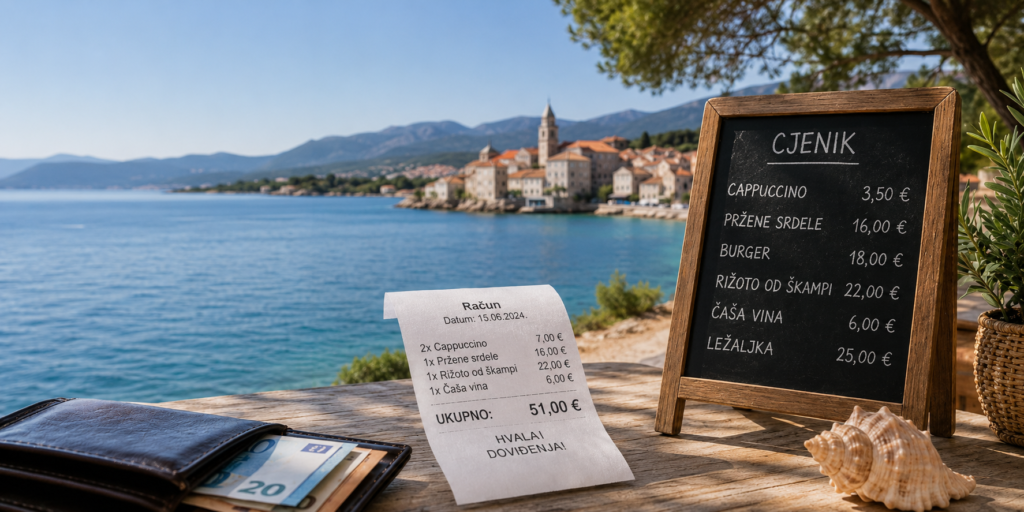
Prices for accommodation, restaurants and shops on Krk are increasingly provoking comments from guests. The problem is not only that Krk has become more expensive, but that guests’ old habits are colliding with new European prices and much higher expectations.
Guests no longer come for the “cheap Adriatic”
Krk and the Croatian coast were, for decades, a more affordable version of the Mediterranean for many guests from Germany, Austria, Slovenia and other European countries.
They came with the expectation that they would get a lot for less money: accommodation close to the sea, a local atmosphere, good food, flexible hosts and the feeling that they had got a good deal.
That relationship has changed.
In terms of prices, Croatia has moved closer to the rest of Europe, and in some tourism segments it can no longer be perceived as a cheap destination at all. But the mental image of some guests has not changed at the same speed. Many still come to Krk expecting the old, more affordable Adriatic, only to find prices that increasingly resemble those in Austria, Italy or France.
That is where the first conflict arises.
The problem is not only the price, but the expectation.
Guests who have been coming to Krk for years do not compare today’s prices only with other destinations. They also compare them with their own memory of Croatia from ten or twenty years ago.
And that Croatia no longer exists.
Krk is not necessarily too expensive in the European context
It would not be fair to say that only Krk is expensive. The whole of Europe has become more expensive.
Anyone who has been skiing in Austria, Slovenia, Italy or France knows that the prices of accommodation, restaurants, coffee, parking, drinks and basic services are often the same as, or higher than, on Krk.
In many European destinations, high prices have long been normal. Nobody expects a cheap lunch at a ski resort, affordable parking in a well-known tourist destination or low prices in a top destination in the middle of the season.
But the difference lies in perception.
A guest who goes skiing in Austria knows in advance that they are entering an expensive destination. A guest who comes to Krk often still carries the old image of the Adriatic as a place where they will get better value.
That is why the same price does not create the same feeling.
On a skiing holiday, guests expect to pay a lot. On Krk, some guests are still surprised when they realize that they have no longer come to a “cheaper Mediterranean”.
The problem is not that it is expensive, but whether it is worth that much
A high price in itself is not the problem. The problem arises when guests do not feel they received value for the money they spent.
If someone pays for excellent accommodation, a good dinner, professional service or a truly high-quality product, they will rarely complain only because the price was high.
But if they pay a serious amount and receive an average impression, average service and average organization, then it is no longer only about the price. It is about the feeling that they overpaid.
That is the most dangerous moment for any destination.
Guests are asking less and less only how much something costs. Increasingly, they are asking whether it is worth that much.
Krk does not have to be cheap. But it has to be convincing.
Accommodation: average can no longer pretend to be luxury
In accommodation, the change is very clear. After the post-pandemic years, many got the impression that prices could only keep rising. Demand was high, guests booked faster, and resistance to high prices was weaker than it is today.
But that market was not normal. It was an exceptional period.
Today, guests compare again. They look at photos, reviews, location, equipment, the pool, distance from the sea, cancellation policy, parking and the overall impression.
An average apartment can no longer have the price of a top-quality property just because it is on Krk.
With holiday homes, this is even more sensitive. Prices are higher, expectations are more serious, and competition is growing. A guest who pays several thousand euros for a week does not expect only a roof over their head. They expect the feeling that the property is truly worth the money.
The market does not punish a high price. It punishes an unrealistic price.
Restaurants: guests do not remember only the bill, but the feeling that they overpaid
Restaurants may be the most sensitive part of this story, because guests experience the bill in a restaurant immediately and personally.
The problem is not that a good restaurant on Krk has high prices. If the food is high quality, the service is good, the setting is well arranged, and the overall impression is professional, guests will more easily accept a higher price.
The problem arises when an ordinary, quick and average offer looks luxurious only on the bill.
When guests pay for ćevapi, squid or some simple dish as if they were sitting in a serious restaurant, while the impression is a plastic plate, rushed service and no atmosphere, they do not only say “it was expensive”.
They say: “we were ripped off”.
That is much worse.
Because one thing is a high price. Another thing is the feeling that someone treated you like a passing tourist who can be charged anything because they may never see you again.
That impression does not remain only in the restaurant. It carries over to the entire destination.
Shops: checkout shock and the other side of the story
A large part of guests’ frustration does not arise in the accommodation or the restaurant, but in the shop.
Sunscreen, hygiene products, water, basic food, children’s items and small everyday necessities often cause a bigger shock than the price of the apartment itself.
A guest comes to the island, goes to the shop, pays the bill and concludes that someone is trying to take advantage of them.
But the story is not that simple.
Local people do not pay those prices only in July and August. On the island, many things are expensive all year round. This is not always tourist exploitation, but a combination of logistics, a smaller market, seasonality, retail policies, lack of competition and island costs.
Because of the bridge, Krk is in a better position than more remote islands, but it is not outside the logic of island life. A smaller winter market, seasonal fluctuations and higher business costs affect prices.
The problem is that the guest does not know this.
They do not see supply chains, business costs, rent, workers or seasonality. They see only the bill. And if that bill is much higher than expected, they reach a conclusion very quickly.
Guests do not judge one price, but the entire holiday
One high price rarely ruins the impression of a holiday.
But several in a row can.
Guests do not judge Krk only by the apartment, restaurant or shop. They add everything together: accommodation, lunch, coffee, parking, traffic, crowds, the beach, cleanliness, service, communication and the feeling of being welcome.
If the accommodation is expensive, the restaurant is expensive, the shop is expensive, parking is expensive, and traffic is exhausting, the guest eventually turns all of that into one sentence:
“It is beautiful, but it is no longer worth that much.”
That is a sentence every destination should fear.
Krk does not have to be cheap, but it must be careful not to become a destination where guests feel like an ATM.
Because guests do not pay only for a bed, lunch or a bottle of water. They pay for the overall feeling that the holiday was worth the money.
Two post-pandemic years distorted many people’s sense of the market
After the pandemic, there was a period that was not a normal market.
Guests wanted to travel. Demand was high. Prices were rising. Bookings came quickly. Many things could be sold at prices and under conditions that would not have worked in more normal circumstances.
The problem is that some accommodation providers and restaurateurs experienced those years as a new rule, not as an exception.
Today, the market is returning to more realistic boundaries. Guests are comparing again, waiting, calculating and commenting. The question of value for money is becoming increasingly important.
The post-pandemic years gave many people the wrong impression that the market had no limit.
It does.
And now we are seeing it again.
Krk does not need to be cheap, but convincing
The biggest mistake would be to conclude that Krk now has to become a cheap destination. It does not. And it should not.
Krk has its location, nature, accessibility, the sea, tradition, gastronomy, holiday homes, family accommodation and proximity to major European markets. These are serious advantages.
But a high price requires serious justification.
If guests are paying European prices, then they expect a European sense of order, service, cleanliness, communication, gastronomy, traffic and respect for the money they spend.
This does not mean luxury at every step. Not every guest expects Michelin, a designer apartment or perfect service. But they do expect the price and the impression to be in balance.
If they pay a serious price, they do not expect a miracle. They expect the feeling that they have not been cheated.
Conclusion
Krk is not too expensive simply because it is expensive.
The problem arises when guests do not see the value for the price they are paying.
Croatia and Krk have moved closer to Europe in terms of prices, but some guests still arrive with the old image of an affordable Adriatic. At the same time, local costs for accommodation providers, restaurateurs, shopkeepers and local people have truly increased. That is why there is no simple answer.
But there is a clear message.
High prices can work. Average quality at a luxury price is becoming harder and harder to sell.
The greatest danger for Krk is not that someone will say it is expensive. The greatest danger is the moment when guests conclude that they can get better value elsewhere for the same money.
And that is why the real question is not only whether prices on Krk are too high.
The real question is: is what we offer worth as much as we ask for it?

