


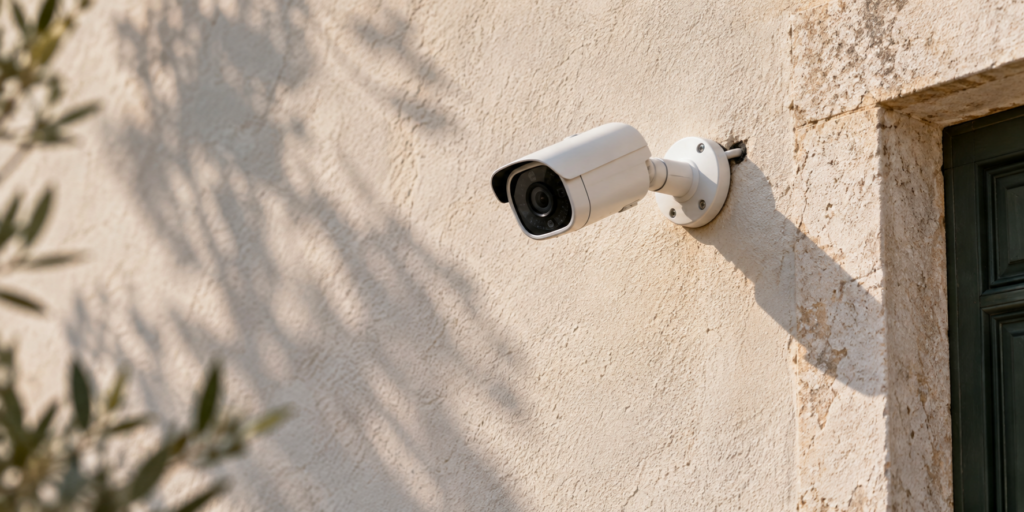
Picture this: guests arrive at the holiday home, unpack, and the children run towards the pool. The father walks around the terrace and notices a small white camera on the wall above the sunbathing area. He doesn't know whether it's switched on, who is watching or whether it also covers the pool. The listing didn't say a word about it. The holiday hasn't even started, and the first impression is already spoiled.
The owner, on the other hand, has perfectly reasonable motives. The house stands empty for most of the year, strangers come and go, in the season the guests change every week, and he may be 800 kilometres away. A camera at the entrance shows whether the guests who booked have arrived, whether they have brought four more friends along and whether anyone has turned up when the house should be empty.
Both sides have a point. So the question is not whether a holiday home may have cameras, but where they may be placed, who has to be told and what to do with cameras that were installed before anyone gave it any thought.
Why owners install cameras in the first place
The reasons are usually very specific: unregistered guests, a party in a house that was rented to a family, checking whether the cleaner came and left, keeping an eye on the entrance while the property is empty in the off-season, and evidence in case of damage. For owners who live abroad, a camera is often the only way to see what is happening with their house at all.
These are all legitimate motives, and they fall under what the law calls the protection of persons and property. The problem begins when the camera stops protecting the house and starts watching the guests: when it points at the sunbathing area, when it records the terrace where they have breakfast, or when the owner opens the app in the evening just to see what they are up to.
What the law says: protecting property yes, monitoring guests no
In Croatia, video surveillance is regulated by the Act on the Implementation of the General Data Protection Regulation. Its rules also apply to private landlords, because renting out a property is not a private activity. In its guidelines on video surveillance, the European Data Protection Board states explicitly that the household exemption does not apply when recording has a professional or commercial dimension. Besides, a landlord is already the data controller for their guests' personal data.
The basic rules of the law are simple:
- A camera may record only for a purpose that is necessary and justified for the protection of persons and property, and only if the interests of the people being recorded do not prevail. Only those parts of the property that are needed for this purpose may be recorded.
- The property must be marked. The sign must be visible no later than on entering the area under surveillance and must contain a simple image and text: that the area is under video surveillance, who the data controller is and a contact that guests can turn to.
- Only a responsible or authorised person may access the recordings, the system must be protected against unauthorised access, and there must be a record of who accessed the recordings, when and where.
- Recordings may be kept for a maximum of six months, unless they serve as evidence in proceedings. Six months is the upper limit, not a recommendation: the European guidelines say that in most cases recordings should be deleted after a few days, and anything longer than 72 hours needs special justification.
- Private individuals may not continuously record public areas. A camera on the gate that covers half the street or the neighbour's garden is not property protection.
For a missing sign, the absence of an access log or the use of recordings contrary to their purpose, the law provides for a fine of up to HRK 50,000, which converts to about EUR 6,636. For unlawful recording itself, for example of an area where no camera may be placed, the Croatian Personal Data Protection Agency can also impose administrative fines under the General Data Protection Regulation. And a hidden camera in a bedroom or bathroom is no longer a data protection matter but one for the Criminal Code, which treats the unauthorised visual recording of a person in a home or in a space protected from view as a criminal offence.
Airbnb has gone a step further than the law
Platforms have their own rules, which apply regardless of national law. Since 30 April 2024, Airbnb has completely banned cameras and recording devices inside listings, even if they are switched off. It makes no difference whether it is a hallway, a living room or a separate guesthouse, and it makes no difference whether the camera is mentioned in the listing. Cameras in common areas used to be allowed if they were disclosed, but that no longer applies.
Outdoor cameras are allowed, but with conditions. Before booking, the host must state in the listing that there are cameras, roughly where they are, for example "camera in the front yard", and whether they are switched on. An outdoor camera may not record the interior or outdoor areas where guests expect privacy, and Airbnb gives an enclosed outdoor shower and a sauna as examples. Doorbell cameras are allowed if disclosed. Noise monitors are allowed in common areas if they do not record sound and are mentioned in the listing.
The consequence of a breach is clear: Airbnb investigates reports and can remove the listing or the entire account. For an owner who gets a good share of bookings through the platform, that is a greater risk than any fine.
Booking.com and other platforms have their own terms, which are best checked directly in the partner extranet. If the property is advertised by an agency, the agency must know about every camera on the property, because the listing has to match the actual situation.
Where a camera may and may not go
The following overview combines the law, platform rules and what guests can reasonably expect. Where these three criteria differ, the table indicates which one applies.
| Location | Camera allowed? | Zašto i na što paziti |
| Front door, doorbell | Yes | Standard entrance protection. A video surveillance sign and a mention in the listing are mandatory. Platforms explicitly allow doorbell cameras. |
| Driveway, gate, parking area | Yes | Record only your own driveway and parking. The camera angle must not cover the street, the road or the neighbour's garden. |
| Exterior of the house: façade, storage shed, utility room | Yes, if necessary | Only areas that genuinely protect the property, with no view of spaces where guests spend their time. |
| Terrace, barbecue area, garden used by guests | Avoid | The law does not explicitly prohibit it, but guests can reasonably expect privacy here and that interest prevails. If a camera covering the entrance has to capture part of the terrace, guests must be told before booking. |
| Pool, jacuzzi, sunbathing area | Do not point cameras here | A space for relaxing, swimwear and children. A camera protecting the pool equipment may record the pump and plant room, not the sun loungers. |
| Outdoor shower, sauna, changing cabin | No | Platforms explicitly list them as prohibited, and the European guidelines describe sanitary facilities and saunas as highly intrusive areas to record. |
| Interior: living room, kitchen, hallway, staircase | No | Banned on Airbnb since 30 April 2024, even when the camera is switched off and even when it is mentioned in the listing. |
| Bedrooms, bathrooms, toilets | Never | The most serious invasion of privacy. A hidden camera in these places is no longer a data protection matter but one of criminal law. |
| Noise monitor without sound recording | Yes, if disclosed | Measures volume only, does not record conversations. Not in bedrooms or bathrooms. Allowed in common areas if mentioned in the listing. |
| Public road, beach, neighbour's property | No | Private individuals may not continuously record public areas or other people's property. |
A camera that "doesn't work" is still a problem
Many owners have had cameras installed for years, since before they started renting out or before the pool was even built. The camera may be switched off, its subscription may have expired, or it may not be connected at all. The guest has no way of knowing this. They see a lens pointing at the sun loungers and behave as if it is recording.
That is why Airbnb worded its ban on indoor cameras so that it also applies to devices that are switched off. The same logic applies to outdoor cameras: a camera facing the pool is a problem even when it isn't recording, because the guest cannot check what the device is doing, and nobody needs an argument about it on the terrace or in a review.
The solution is physical, not verbal. A camera covering an area where it shouldn't be must be removed, turned so that it records only what it is allowed to, or covered so that anyone can see it cannot record. The explanation "don't worry, that one doesn't work" rarely reassures guests, and if the camera does record after all, it puts the owner in an even worse position.
Three places where guests must learn about the camera
Once the cameras are in the right places, the question of transparency remains. This is where most mistakes happen, and not because anyone is hiding something, but because nobody thought about it.
The first place is the listing. On Airbnb this is the mandatory field for safety devices; on other platforms and on your own website it is the property description or the house rules. A sentence such as "The property has an outdoor camera at the front door and in the parking area. The cameras do not cover the pool, the terrace or the interior." clears up most doubts before they arise.
The second place is the sign on the property. The law requires it to be visible before entering the area under surveillance and to contain an image and text: that the area is under video surveillance, who the data controller is and a contact. A sticker with a camera pictogram but no name or contact is formally not enough.
The third place is the guest information and house rules. A guest who has read that the camera records the entrance for security reasons and that only the owner views the footage if there is a problem will rarely have any objection. A guest who discovers the camera on their own almost always will.
This also calls for discipline with the recordings. Access should be limited to the owner or a person they authorise, not anyone who knows the password. Recordings are deleted automatically after a few days. Footage of guests does not go into a WhatsApp group or onto social media, not even when it is funny, because that is use contrary to the purpose, for which the law provides a fine. Reviewing footage makes sense when there is a specific reason: damage, suspicion of unregistered persons, someone on the property when the house should be empty. Watching guests every day is not property protection.
Fewer cameras, better placed
There is also a side that the law doesn't show. A guest who has paid for a house with a pool has bought the feeling that the place is theirs alone for a week. Every camera, even a perfectly legal one, takes a little away from that feeling. So the question for the owner is rarely how many cameras, but which one or two actually do the job.
For most holiday homes, that is a camera at the entrance or doorbell and, if needed, a camera at the parking area or gate. This covers who comes in, how many there are and when they left, without touching what the guests came for. The number of people in the house is easier to control with clear house rules, a deposit and a local host's contact than with a camera pointed at the pool. For noise, there are monitors that do not record sound.
A quick check before the season
Before the guests arrive, it is worth walking through the house through a guest's eyes:
- Can any camera see the pool, jacuzzi, sunbathing area, terrace used by guests, outdoor shower or interior? If so, turn the camera, remove it or cover it visibly.
- Does any camera capture the street, the beach or the neighbour's garden? Narrow the recording angle.
- Is there a camera indoors, even a switched-off one? On Airbnb, this can mean the listing is removed.
- Are the cameras mentioned in the listing and the house rules, with their location?
- Is there a sign at the entrance with a pictogram, the name of the data controller and a contact?
- Who has access to the recordings, and after how many days are they deleted?
A camera at a holiday home is not the problem. The problem is a camera the guest didn't know about, in a place where they didn't expect it.
Sources
- Act on the Implementation of the General Data Protection Regulation (Official Gazette NN 42/2018), Articles 25 to 32 and Article 51: https://narodne-novine.nn.hr/clanci/sluzbeni/2018_05_42_805.html
- Croatian Personal Data Protection Agency, Processing of personal data through video surveillance: https://azop.hr/obrada-osobnih-podataka-putem-videonadzora/
- European Data Protection Board (EDPB), Guidelines 3/2019 on processing of personal data through video devices: https://www.edpb.europa.eu/sites/default/files/files/file1/edpb_guidelines_201903_video_devices_en_0.pdf
- Airbnb Help Center, Security cameras and recording devices (article 3061): https://www.airbnb.com/help/article/3061
- Airbnb Newsroom, An update on our policy on security cameras, 11 March 2024: https://news.airbnb.com/an-update-on-our-policy-on-security-cameras
- Criminal Code (Official Gazette NN 125/11 to 136/25), criminal offences against privacy: https://www.zakon.hr/z/98/Kazneni-zakon
Sources checked on 23 September 2026. The fine was converted from kuna at the fixed conversion rate of 7.53450. The table and recommendations are an editorial application of the regulations and platform rules to holiday rentals.

