



One of the most common questions private accommodation providers hear during the season is: “Can we arrive earlier?”
Right after that comes the second one: “Can we leave a little later?”
At first glance, it sounds like a small thing. The guest arrived on Krk earlier, it is hot, the children are nervous, the car is full of luggage, and the ferry or flight dictated their schedule. On the other hand, the accommodation provider knows what the guest often does not see: the previous guests may have left only at 10, the bed linen has to be changed, the bathroom cleaned, the floors washed, the terrace tidied, the rubbish taken out, and the cleaning service has several other properties to prepare on the same day.
That is why early check in and late check out are not a matter of goodwill, but of organization.
In many apartments and holiday homes, the standard is simple: check out by 10 a.m., check in from 4 p.m.This is not there to make things difficult for guests, but to leave enough time between two turnovers for the accommodation to be brought into the condition the new guest expects.
The problem arises when the guest thinks the apartment is empty as soon as the previous guest closes the door.
It is not.
That is when the work begins.
Guests often do not understand what happens between 10 a.m. and 4 p.m.
Accommodation providers know this perfectly well, but guests often do not. They are not in this business and do not think like hosts, cleaners or agencies.
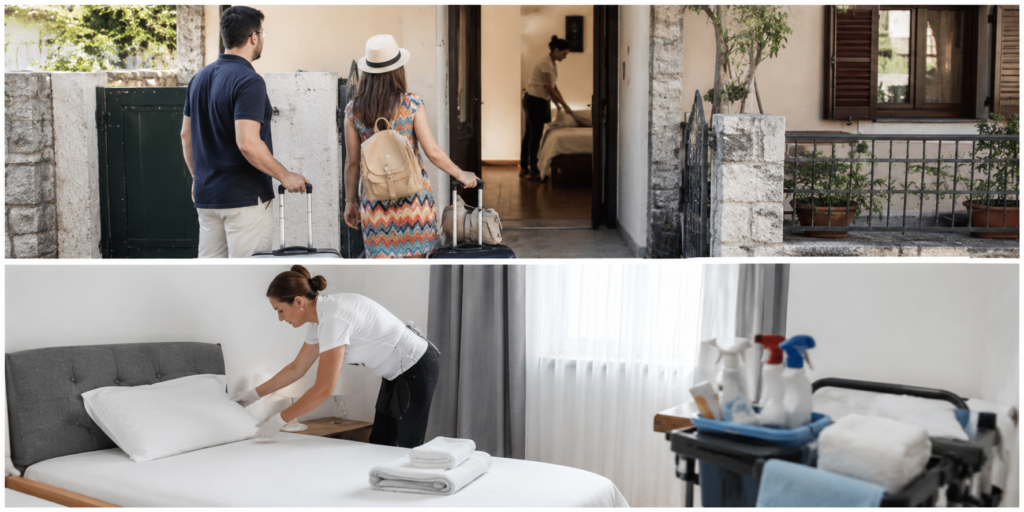
Guests see only their own situation: they arrived at 11 a.m. and want to enter. They do not see that the previous guests may have left five minutes before the deadline, that there is a lot of laundry to wash, that the air conditioning, boiler, kitchen, refrigerator, terrace, pool or barbecue need to be checked. They also do not see that the cleaning service may have to visit five properties on the same day.
That is why the first thing is communication. The guest should be calmly and simply told the basics:
“The previous guests’ check out is until 10 a.m., and after that the accommodation must be cleaned and prepared. As soon as it is ready earlier, we will let you know.”
That is much better than a cold: “You cannot enter before 4 p.m.”
The accommodation provider must be clear, but does not have to be rude.
Early check in is not a guest’s right, but an additional possibility
Arrival and departure times are not a rough recommendation, but part of the booking conditions. If the guest booked accommodation with check in from 4 p.m. and check out by 10 a.m., then they are expected to respect those times, unless otherwise agreed in advance with the host.
This is an important message for accommodation providers as well: arrival and departure times are not “approximately”. They are part of the booking rules.
Of course, if the accommodation is ready earlier, the guest can be informed and allowed to enter before the official check in time. That is excellent practice. Guests remember it, feel welcome and often rate the host better. But it is important that the guest understands that this is a convenience, not an obligation.
The best wording is:
“Official check in is from 4 p.m. If the accommodation is ready earlier, we will gladly let you know.”
This sets expectations properly. The guest knows that earlier entry may be possible, but does not count on it as a guaranteed right.
“Can we just leave our things?” is often not that simple
Another common question is: “Can we just leave our suitcases?”
Sometimes this really is simple. If there is a safe space, reception, storage room or an agreed place, there is no problem.
But in private accommodation, it is often not that easy. If the previous guests are still inside, luggage cannot be left in the apartment. If the cleaners are working, suitcases get in their way. If the guest leaves things on the terrace, in the hallway or in a shared space, the question of safety and responsibility arises. If something goes missing, the host gets pulled into an unnecessary problem.
That is why it is better not to promise something that cannot be controlled.
A good sentence:
“Luggage storage is possible only if there is a safe space and if we confirm it in advance. Otherwise, the accommodation is available from the official check in time.”
That is not unfriendly. It is professional.
Parking, pool and terrace before check in are also part of the problem
Guests often do not ask only for the apartment. They ask for parking, a toilet, terrace, refrigerator, pool or “just to change clothes”.
But if check in is from 4 p.m. and the guest arrives at 11 a.m., the question is not only whether they can enter the room. The question is whether they can use the facilities that belong to the accommodation before their stay has started.
With holiday homes, this can be a major problem. If the previous guests have check out until 10 a.m., and the new guests arrive earlier and want to use the parking or pool, an uncomfortable encounter can easily happen. In apartment houses, it can happen that new guests occupy the parking before the old guests have even left.
That is why it should be written in advance:
“Use of parking, pool and other facilities is possible from the check in time, unless otherwise agreed.”
The guest should be told this before arrival, not when they are already standing at the door.
Late check out can be an even bigger problem
Late check out is often more difficult than early check in.
If a guest asks whether they can leave at 11 or 12, to them it sounds like “just another hour or two”. For the accommodation provider, it can disrupt the entire day.
If a new guest is arriving the same day, every hour of later departure reduces the time available for cleaning. The cleaning service is not waiting for only one property. Bed linen has to be replaced, the bathroom cleaned, the kitchen checked, the rubbish taken out, and any possible damage noticed before the new guests arrive.
That is why late check out should not be a matter of negotiation on the day of departure, especially if new guests are arriving the same day.
The best wording:
“Check out is by 10 a.m. because we have to prepare the accommodation for the next guests on the same day. Later departure is possible only if there is no new booking that day and if we confirm it in advance.”
This clearly tells the guest that the problem is not personal. The problem is the schedule.
Charging for early check in and late check out can be good protection
Many accommodation providers are afraid to charge for early check in or late check out because they think the guest will see it negatively. But a clear price often reduces pressure.
If early entry is possible, it can be offered as an additional service. For example:
Early check in from 12 to 4 p.m., if available, with a surcharge of 50 percent of the daily price.
The same applies to late check out:
Late check out between 10 a.m. and 12 noon, if available, with a surcharge of 50 percent of the daily price.
This has two effects.
The first is fair: if the guest wants to use the accommodation outside the agreed time, that has value.
The second is practical: the guest suddenly starts taking the official time more seriously. When “just a little earlier” is free, the request is easily repeated and expanded. When there is a price, the guest assesses more carefully whether they really need it.
It is important that the charge does not sound like a penalty. It should be presented as an option:
“If you would like guaranteed earlier entry, we can offer it only if available, with a surcharge.”
The word “guaranteed” is key here. If the guest wants certainty, that certainty is charged. If they do not want to pay, they can wait for the official check in or get in touch when they are nearby and see whether the accommodation is already ready.
The best model: flexibility when possible, rules when necessary
The goal is not to be rigid. A good accommodation provider should not keep an empty, cleaned apartment locked until 4 p.m. just because that is what the rules say.
If the accommodation is ready at 1 p.m., the guest can be informed:
“The accommodation is ready earlier, you may arrive.”
That is the best kind of service: it costs the accommodation provider nothing, and it means a lot to the guest.
But it must not become an obligation with every booking. If the guest is promised earlier entry in advance without checking, the host creates a problem for themselves. A better wording is:
“Please contact us when you are nearby, and then we will know whether we can receive you earlier.”
That is realistic and practical. On the day of arrival, the host already knows when the previous guests left, where the cleaning service is and how much longer it will take to finish.
The most common mistake: promising too much before arrival
Sometimes, in an effort to be kind, the accommodation provider writes:
“You can come earlier, no problem.”
And then a problem happens. The previous guests leave late. Cleaning is delayed. Something is damaged. The bed linen has not arrived. The air conditioning is leaking. The new guest is already standing at the door and is angry because earlier entry was promised.
That is why two things need to be distinguished:
Possible is not the same as guaranteed.
The safest communication:
“Official check in is from 4 p.m. Earlier entry is not guaranteed, but if the accommodation is ready earlier, we will gladly let you know.”
That is a sentence that saves nerves.
How to avoid a bad review?
Bad reviews often do not happen because the guest was not allowed to enter earlier, but because they feel that nobody explained why they could not.
That is why it is important to explain the logic in advance:
“The previous guests have check out until 10 a.m., and after that we need time for cleaning and preparation. We want you to receive the accommodation clean and ready, which is why we can confirm earlier entry only on the day of arrival.”
This sentence works better than a rule without explanation. It gives the guest a reason.
The same applies to late check out:
“We understand that you would like to stay longer, but new guests are arriving the same day and we have to prepare the accommodation for them on time.”
The guest may not be thrilled, but they will find it much harder to leave a bad review if the communication was clear, polite and timely.
What should the accommodation provider have set in advance?
The most important thing is that rules are not created at the moment when the guest has already asked.
The listing, booking confirmation or pre arrival message should clearly state:
- check in is from 4 p.m.,
- check out is by 10 a.m.,
- earlier entry is possible only if the accommodation is ready,
- later departure is possible only if there are no new guests arriving,
- leaving luggage, parking and using facilities before check in are possible only by arrangement,
- guaranteed early check in or late check out may be charged.
When the rules are clear in advance, it is harder for the guest to claim that they did not know.
Conclusion
Early check in and late check out are not small details. In private accommodation, especially during the season on Krk, they often determine whether a turnover day will pass calmly or under stress.
Guests should be accommodated when possible. If the apartment has been cleaned earlier, let them know they can arrive. If there is no new booking, later departure can be a nice gesture or an additional service.
But the accommodation provider must not allow kindness to become an obligation, or “just a little earlier” or “just one hour later” to become a problem for cleaning, new guests and the entire schedule.
The best rule is simple:
Flexible when possible, clear when it is not.
If the guest wants guaranteed earlier entry or later departure, it can be offered with a surcharge. If they do not want to pay, the standard times apply. If the accommodation is ready earlier, the host can let them in without a surcharge.
That way, both the service and the accommodation provider’s authority are preserved.
Practical framework for accommodation providers
Standard time:
Check in from 4 p.m., check out by 10 a.m.
Best pre arrival message:
“Official check in is from 4 p.m. If the accommodation is ready earlier, we will gladly let you know. You can contact us when you are nearby, and then we will have more accurate information.”
Best message for early check in:
“Earlier entry is not guaranteed because the previous guests have check out until 10 a.m., and after that cleaning has to be done. If you would like guaranteed early check in, we can check availability and offer it with a surcharge.”
Best message for late check out:
“Check out is by 10 a.m. because of cleaning and preparation for the next guests. Later departure is possible only if we do not have a new arrival that day and if we confirm it in advance.”
Charging model:
Early check in from 12 to 4 p.m., if available: 50% of the daily price.
Late check out from 10 a.m. to 12 noon, if available: 50% of the daily price.

