


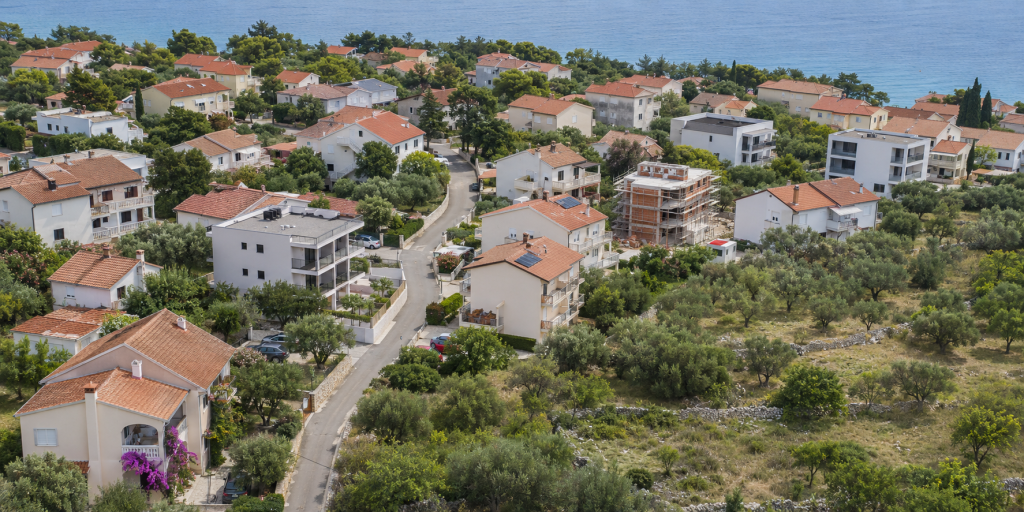
The Krk Island Tourist Board has published the draft Destination Management Plan for the island of Krk 2026 – 2029, together with a carrying-capacity assessment. The document was prepared jointly with the Town of Krk and the municipalities of Baška, Dobrinj, Malinska-Dubašnica, Omišalj, Punat and Vrbnik, and the public consultation runs until 2 December 2026. At first glance it is just another strategy paper. For hosts and holiday-home owners it is more than that: for the first time, one document brings together the figures that show how much private accommodation has grown and what the municipalities can do about it.
What the plan establishes
The authors' conclusion is blunt: Krk is a mature destination that in many respects is reaching, or has already reached, the acceptable level of its carrying capacity. Traffic is already at the limit, while the municipalities' spatial plans still allow further construction that could undermine the island's sustainability in the long run.
Among the areas the plan singles out for special attention, the structure of accommodation capacity and the intensity of commercial and non-commercial tourism come first. In other words: how many beds the island has, in what kind of properties, and how much they are actually used.
Figures worth remembering
| Figure (2025) | Island of Krk |
|---|---|
| Household rental properties | 5,736, average 5.4 beds |
| Share of household rentals in total capacity | 53 % |
| Share of household rentals in overnight stays | 44 % |
| Holiday homes and flats (property tax 2024) | 16.991 |
| Non-commercial overnight stays in holiday homes and flats | 1.3 million |
| Possible new construction on undeveloped parts of settlements | 17,858 housing units |
The largest household-rental capacity is in Krk (25% of the island's total) and Malinska-Dubašnica (23%), followed by Baška (16%) and Dobrinj (14%). For holiday homes and flats that are not rented out, the order is different: Malinska-Dubašnica has around 3,500 such properties with 14,504 beds, Dobrinj 2,300 and Krk 1,900.
The figure that best describes the problem: beds in holiday homes and flats are used on average for 12 days a year in Krk and up to 38 days in Dobrinj. The properties stand empty for most of the year, yet they put pressure on space, water, electricity and traffic in the same six weeks as everyone else.
The data on quality is also telling. Three-star properties make up 47% of the island's capacity but are used below average. Five-star properties have a share of overnight stays 25% higher than their share of beds, four-star properties 11% higher. Guests on Krk are increasingly choosing the better options, while average accommodation is the most plentiful.
What guests say
The plan also includes the results of a guest survey. Most guests know the island well: 59% have visited more than once in the past five years. Satisfaction with the overall stay was rated high, but below the average for Kvarner and Adriatic Croatia. Value for money, accommodation, food and drink, beach facilities, events and the offer for children received medium ratings. Traffic in the resorts was rated worst. The result is a below-average willingness among guests to recommend Krk to others.
Limiting construction: what the plan actually proposes
This is the part owners care about most, so it deserves a careful reading. The plan itself does not introduce any ban or restriction. Among the measures for all local authorities is Measure 1.4, “Spatially balanced development of accommodation capacity”, and the only activity under it reads: exploring the options for limiting or slowing the growth of holiday homes, holiday flats and tourist apartments.
So it is an exploration of options, not a decision. But the legal framework for a decision exists. Under the Tourism Act (Official Gazette 156/23), a town or municipal council may, on the basis of a destination management plan and a carrying-capacity assessment, adopt a decision on the number, type and category of accommodation establishments and on accommodation capacity, in part or all of its territory. The December 2024 amendments to the Hospitality Act (Official Gazette 152/2024) added that the competent authority issues categorisation licences in line with such decisions.
In practice this means the following. Once the plan is adopted, every municipal council on Krk will have a document it can cite if it decides to restrict new categorisations, for example in certain settlements or for certain types of property. Whether anyone will do so, when and in what form, nobody knows at this point. The plan also reckons with growth: in the scenario of heightened investor interest it projects around 6,000 more holiday homes and flats, on top of the current growth of 4.2% a year.
Anyone building, buying or planning a first categorisation should take this into account now. What you need to know about the procedure before submitting an application is covered in our article on categorising new holiday homes, and foreign owners will find further information in the guide for non-residents.
What the plan offers hosts
It is not all about restrictions. The plan provides for ten measures and 24 activities, several of which directly concern private accommodation: a training programme for household hosts (furnishing, maintenance, added-value services, guest relations, promotion and sales), support for adapting properties to specific market segments, environmentally responsible practice in rental properties, and the development of accommodation in rural villages through the renovation of existing buildings. Alongside these come measures for traffic and parking, the biggest source of irritation for guests and residents alike.
How to submit a comment by 2 December
The draft plan and the consultation are open on the e-Savjetovanja portal. The full text can be read without logging in. To submit a comment you need to log in through the Croatian e-Građani system, after which you can comment on an individual chapter or on the document as a whole. Comments from hosts make the most sense on Measure 1.4 and on the chapter on accommodation capacity, as these are the parts the municipalities will later refer to.
One note for those who will read the document: the table rating the carrying capacity reached in each municipality in red, yellow and green has been published in the draft as an image, so the status of an individual municipality cannot be read unambiguously from the text.
Krk danas Editorial Team
Sources
Draft Destination Management Plan for the island of Krk 2026 – 2029 and carrying-capacity assessment, e-Savjetovanja (2 November 2026)
Tourism Act (Official Gazette NN 156/23)
Act on Amendments to the Hospitality Act (Official Gazette NN 152/2024)
