


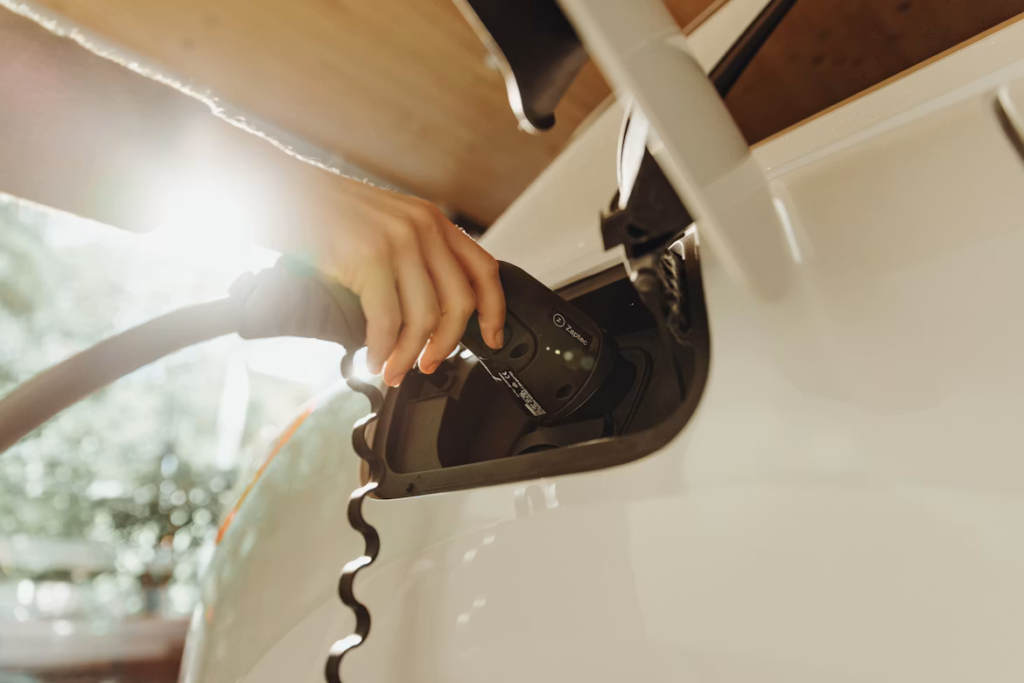
Electric cars and plug in hybrids are increasingly common on the roads, and this is slowly becoming visible in private accommodation as well. Krk is clearly a car destination: most guests arrive with their own car, stay for several days or weeks, and increasingly ask whether they can recharge their vehicle during their stay.
For accommodation providers, this raises several practical questions: should they install a wallbox right away, can charging be done through a regular socket, how much does it really cost, will the limiter trip, and does it make sense to charge guests for charging.
The good news is that charging an electric vehicle in private accommodation is usually neither a major cost nor a major problem. The bad news is that it can become a problem if it is done recklessly: through a window, with an old extension cable, from the first socket closest to the guest.
That is why the best approach is simple: do not panic, do not ban it in advance, but clearly define where and how the vehicle can be charged.
Guests do not expect a fast charger in the yard
Most guests who arrive with an electric car do not expect an apartment or holiday home to have a public fast charger. In practice, slow overnight charging is usually enough for them.
This means that the car is parked overnight and charged at a lower power. This gives the guest enough energy for driving around the island, going to the beach, the shop, a restaurant or for a more relaxed drive back to the next public charging station.
This is important to understand because accommodation providers often get worried as if every guest will charge a completely empty electric car from 0 to 100 percent. That does not happen so often in tourist accommodation. On holiday, the car is generally used less, and charging is most often a top up, not “filling the tank to the top”.
How much does it really cost?
For accommodation providers, the most important thing is the real additional cost. For a simple and cautious calculation, a figure of around 0.20 euros per kWh. The actual price depends on the tariff, consumption, network charges and the total bill for the property. HEP states that energy prices differ by tariff model, that they do not include the costs of using the distribution and transmission network or the special fee for renewable energy sources, and that for the period from 1 April to 30 September 2026, a threshold of 3,000 kWh also applies, above which consumption is charged according to tariff items increased by 35 percent.
An approximate calculation looks like this:
| Guest consumption | What it means | Approximate cost for the host |
|---|---|---|
| 10 kWh | smaller plug in hybrid | around 2 € |
| 20 kWh | larger plug in hybrid or smaller EV top up | around 4 € |
| 30 kWh | good overnight top up of an electric car | around 6 € |
| 50 kWh | larger top up of an electric car | around 10 € |
| 70 kWh | almost a full charge of a larger battery | around 14 € |
With plug in hybrids, we are usually talking about a few euros. With a fully electric car, the amount can be higher, but it is still most often not a dramatic cost, but a top up of several dozen kWh.
In a holiday home that is charged several hundred euros per night, such a cost is usually negligible. In lower priced apartments, especially outside the season, the cost should be kept under control, but it is still generally not a reason for conflict with the guest.
Wallbox or ordinary socket?
A wallbox is the best and neatest solution, but it is not mandatory for every accommodation provider.
An ordinary household socket usually allows slow charging at around 2.3 kW, a stronger single phase option can be around 3.6 kW, and a three phase 16 A connection provides around 11 kW. Technical sources for electric vehicle charging list exactly these values as typical: a household Schuko socket 230 V/10 A at around 2.3 kW, a blue CEE socket 230 V/16 A at around 3.6 kW, and a red three phase CEE 400 V/16 A at around 11 kW.
In practice, this means:
| Solution | Most suitable for |
|---|---|
| Ordinary checked socket | plug in hybrids and slow overnight top ups |
| Stronger single phase socket | small apartments and houses where fast charging is not needed |
| Wallbox with lower or adjustable power | better control and safer charging |
| 11 kW wallbox | holiday homes, villas and properties with sufficient connection capacity |
Important: not every wallbox necessarily means “11 kW or nothing”. There are devices where the power can be limited. This is often the best option for tourist accommodation: not to charge as fast as possible, but safely enough and slowly enough for the house to function normally.
The real problem is often the limiter
The biggest practical problem is not the electricity bill, but the connection capacity of the house.
In summer, air conditioning units, boilers, washing machines, kitchen appliances, the pool pump, lighting and refrigerators are all running at the same time. If a car that draws 11 kW is added to that, the limiter may start tripping.
That is why it is not smart to write “EV charger” in the listing just because it sounds modern. If the property does not have enough power capacity, the guest will be dissatisfied, and the host will constantly be dealing with power outages.
It is smarter to write realistically:
“Slow electric vehicle charging is possible by prior arrangement.”
That is fair to the guest and safer for the host.
An ordinary socket can work, but only if it is not improvised
Charging through an ordinary socket can be quite sufficient for occasional slow top ups. But it must not be done just any way.
It is not good for the guest to run their own extension cable from the apartment, through a window, across the terrace, stairs or parking area. It is not good to charge from an old socket whose condition nobody knows. It is also not good for the guest to decide on their own where they will plug in.
The best approach is for the accommodation provider to define one charging point in advance. Even better, an electrician should check the installation and prepare an outdoor socket or connection used specifically for that purpose.
This does not have to be a major investment. Often it is enough to arrange one safe point for slow charging and clearly tell the guest that the vehicle may be charged only there.
What is the best solution by property type?
For holiday homes and villas, the simplest solution is to include charging in the price. The guest pays for the entire property, parking, comfort and often a pool as well. If there is a safe socket or wallbox, slow electric vehicle charging should be part of the normal service.
For one or two apartments in a family house, the most reasonable option is to allow free slow charging on one phase, by arrangement. The cost is usually small, and it means a lot to the guest.
For larger apartment houses, the situation is different. If you have several apartments and several parking spaces, several electric vehicles may appear at the same time. In that case, the biggest problem is no longer the price of one top up, but order: who charges, when they charge, for how long, and whether one guest’s charging will disturb others.
There, it may make sense to introduce a schedule, a limit, a flat fee or a wallbox with metering. In larger properties, charging a fee can be justified, but it must be clear and simple.
| Type of accommodation | Recommendation |
|---|---|
| Holiday home / villa | include charging in the price |
| One or two apartments | allow free slow charging by arrangement |
| Larger apartment house | introduce control, schedule or charging fee |
| Old house with weak electrical installation | electrician’s inspection first |
| Property with a pool and many air conditioning units | charging only with power limitation |
Does it make sense to charge for charging?
For small properties, often not.
If a guest uses 15 or 20 kWh, we are talking about a few euros. If the host introduces special charging, measurement and discussion because of that, they may appear petty and disorganized.
For holiday homes, charging for electric vehicle charging generally makes no sense. It is a cost that can be included in the price of the stay, like air conditioning, Wi-Fi or a washing machine.
For smaller apartments, free slow charging is often the best compromise.
For apartment houses with several units, charging a fee can make sense, but only if there is a clear system. A charger with a card, app or record solves part of the problem, but also opens new questions: who keeps the records, how the fee is charged, how the invoice is issued and what happens if the guest disputes the consumption. For that reason, charging a fee makes more sense for larger properties than for small family accommodation providers.
Electric cars are not the problem, poor communication is
Electric cars are not a threat to accommodation providers. They are part of a new guest profile, especially among guests coming from countries where electric vehicles are already common.
A guest who drives an electric car usually only wants to know whether they can recharge it and under what conditions. If the host clearly says that slow charging is possible at a designated place, without extension cables and by arrangement, most problems disappear.
On the other hand, a complete ban without explanation can leave a bad impression. It is even worse if the guest finds out only upon arrival that they are not allowed to charge, even though they were counting on that possibility.
One bad review can cost more than several overnight car top ups.
Conclusion
Charging electric vehicles in private accommodation will not disappear. There will be more of it, especially on Krk, where most guests arrive by car.
For accommodation providers, the most important thing is not to complicate things, but also not to improvise. Not everyone needs to install an expensive wallbox immediately. Often, a checked socket, limited power and an agreement with the guest are enough.
The most reasonable model is this:
Holiday homes: include charging in the price.
Small apartments: allow free slow charging on one phase, by arrangement.
Larger apartment houses: introduce rules, a schedule and, if necessary, charging.
The cost is usually lower than people fear. With plug in hybrids, it is often 2 to 4 euros. With an electric car, it is most often a top up, not charging the entire battery.
A guest’s electric car should not be seen as a problem, but as one more thing that a good accommodation provider can solve simply, safely and without stress.

