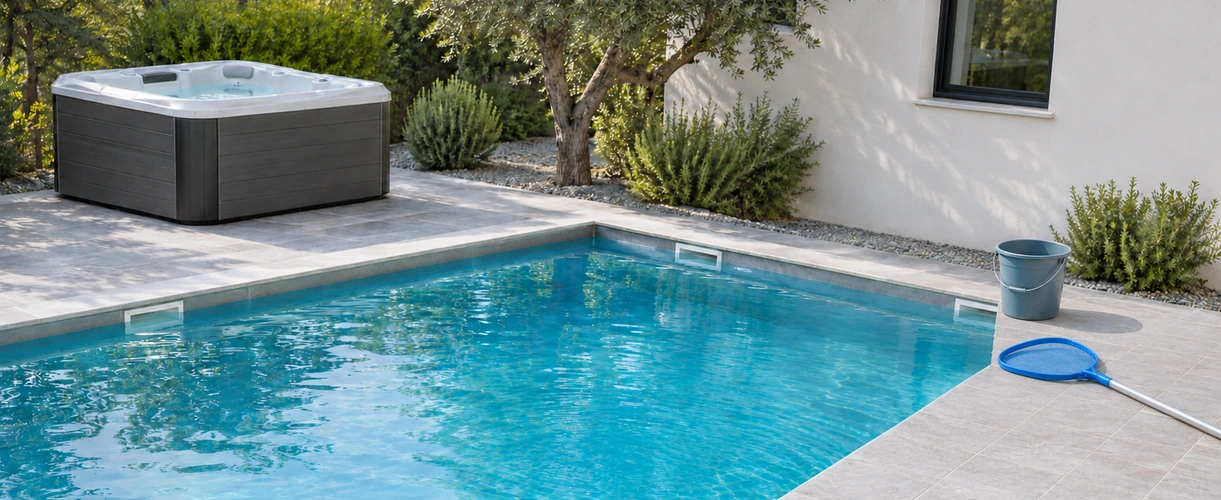
How often a pool needs servicing, why the pump should not run on a timer in July, what pH and free and combined chlorine mean, whether salt is better than chlorine, what a hot tub needs and how the pool gets through winter. Clear water is not necessarily safe water, and only testing shows the difference.
1. How often the pool is serviced in season
The number of visits depends on how the water is disinfected.
Salt electrolysis
Once a week. The unit produces chlorine itself, but the water and equipment are checked by hand on every visit.
Manual chlorine dosing
Twice a week. Between visits, the chlorine level depends on the weather, dirt and the number of swimmers.
Outside the schedule
After storms and whenever the water needs it, without waiting for the next visit.
On each visit:
- Testing pH and chlorine and dosing according to the readings, not by guesswork.
- Emptying the skimmer and pump baskets.
- Vacuuming the floor, by robot or by hand, and cleaning the waterline, steps and corners.
- Checking the filter pressure and backwashing the filter when the pressure is high.
- Checking the water level and, with electrolysis, the salt level, the cell and messages on the unit.
- Checking the heating and the cover, if the pool has them.
- Recording the readings and the products added. Without records you cannot see when a problem started.
A robot vacuums the floor and part of the walls and keeps the pool tidy between visits. It does not test, dose or clean the filter, so a pool can have a spotless floor and poor water. The waterline, steps and corners have to be cleaned by hand, and so does the whole pool after a storm or an algae bloom.
There is less work if fewer leaves fall into the pool. What to plant near the pool, and what not, is covered in the guide Garden Maintenance.
2. Filtration: in peak season the pump runs non-stop
Chlorine and all other products only work in water that circulates and passes through the filter. When the pump stops, water spoils quickly in summer heat, however much chlorine has been added.
The most common owner mistake is the timer. In July and August the pump should run all the time. Owners who switch it to a few hours a day to save money save a few euros of electricity and spoil the water for a whole week. Recovering that water costs more than the saving: extra chemicals, extra visits and guests who cannot swim for several days.
Outside the peak the pump can run for shorter periods. How long is decided by whoever maintains the pool, based on water temperature and the number of swimmers.
- A sand or glass filter is backwashed when the pressure on the gauge rises. Backwashing uses water, so the level is topped up afterwards.
- A cartridge filter, common in hot tubs and smaller pools, is not backwashed. The cartridges are taken out and washed, and replaced over time.
- The water level must be at the height of the skimmer opening. When it drops below, the pump draws air and circulation stops.
3. Water chemistry: pH, free and combined chlorine, stabiliser
Cloudy water is not always a sign of too little chlorine, and clear water is no proof that everything is fine. That is why the water is tested, and for more than one value.
| What is tested | Value | What happens outside the range |
|---|---|---|
| pH | In practice 7.2 to 7.6. The regulation allows 6.5 to 7.8. | Too high: chlorine works less well, the water turns cloudy and scale forms. Too low: it stings eyes and skin and corrodes metal parts. |
| Free chlorine | 0.2 to 1.0 mg/l | Too little: the water is unprotected and quickly turns green. Too much: it irritates skin and eyes, so swimming is postponed until the value drops. |
| Combined chlorine | As low as possible | A chlorine smell and stinging eyes. |
| Stabiliser (cyanuric acid) | Maximum 50 mg/l | Chlorine shows up on the test but works poorly in the water. |
The legal limits for pH, free chlorine and stabiliser come from Annex I of the Croatian Ordinance on Sanitary, Technical and Hygiene Conditions for Swimming Pools (NN 59/20).
pH determines how well chlorine works at all, so pH is tested and corrected first, and chlorine after that. pH minus lowers the value, pH plus raises it. Both are dosed according to the pool volume, and the water is tested again after circulation.
Free, combined and total chlorine
Knowing that there is chlorine in the water is not enough. What matters is how much of it is still active.
Free chlorine is still active and can disinfect. Combined chlorine has already reacted with sweat, sun cream, urine and other organic dirt: it disinfects poorly, but causes the smell and irritates eyes and skin. Total chlorine is the sum of the two.
Combined chlorine is total chlorine minus free chlorine. That is why a pool that smells strongly of chlorine usually does not have too much chlorine, but too little active chlorine: it has been used up on dirt and stays in the water as combined chlorine.
| Measurement result | What it means | What to do |
|---|---|---|
| Free chlorine in range, total about the same | The water is fine, provided the pH is also in range. | Regular maintenance. |
| Free and total chlorine both low | Not enough disinfection. | Check pH, add chlorine, increase filtration. |
| Free chlorine low, total high | There is a lot of combined chlorine, the water is overloaded. | Check pH and filtration, carry out a shock treatment. |
| Free chlorine too high | The water irritates skin and eyes. | Do not add chlorine, keep filtering, swim only when the value drops. |
Tablets, granules and other products
- Chlorine tablets dissolve slowly and maintain the chlorine level. They go in a dispenser or the skimmer and must never lie on the liner. Most contain stabiliser.
- Chlorine granules is used for quick correction and shock treatment. In lined pools it is dissolved first so it does not fall straight onto the floor. After a shock treatment the pool is not used until the values are back in range.
- Multifunctional tablets contain algaecide, flocculant and stabiliser as well as chlorine. They are convenient, but they also add what the water does not need at that moment.
- Flocculant binds fine particles that the filter does not catch. It is used in a targeted way, after pH, chlorine and the filter have been checked. Too much makes the water even cloudier, and some flocculants are not suitable for cartridge filters.
- Algaecide helps against algae, but does not replace chlorine, filtration or correct pH. If the water is green, first find out why.
Stabiliser: when there is chlorine but it does not work
Stabiliser protects chlorine from breaking down in sunlight, which is useful in an outdoor pool. The problem is that it does not leave the water. Every stabilised tablet adds a little more, so after a few seasons without changing the water there is too much of it.
The test then shows chlorine, yet the water still turns green. The owner adds more tablets and makes it worse. The only fix is a partial water change.
4. Chlorine or salt electrolysis
A salt pool is not a chlorine-free pool. The unit makes chlorine from salt dissolved in the water, so the disinfection is the same, only the chlorine is produced in the system instead of being added by hand. The water is slightly salty, many times less than the sea.
| Chlorine (tablets, granules) | Salt electrolysis | |
|---|---|---|
| Initial investment | Low | Unit, cell, probes and installation |
| Visits in season | Twice a week | Once a week |
| Chlorine level | Depends on dosing, can drop between visits | More stable, the unit produces chlorine while the pump runs |
| Breakdowns and consumables | Little equipment that can break | The cell wears out and is replaced, and probes and electronics can fail |
| pH | Corrected according to tests | Usually rises, so it needs regular correction or automatic dosing |
| Stabiliser | Builds up from tablets | Does not build up if no stabilised products are added |
| Water for guests | Good when balanced | Softer, slightly salty and odourless |
Electrolysis gives better water and needs fewer visits, and guests like that water. It costs more, has more that can break, and the cell is a consumable part that needs replacing after a while. It does not run itself: a manual check on every visit is still essential, because a salt pool can also have cloudy water, algae, scale on the cell or too little free chlorine.
Chlorine is the classic option and works well when someone is often at the pool and looks after it. Its weak point is the time between visits: heat, a storm or a full house use up the chlorine faster than expected, and the water spoils before anyone comes.
For a rental house where the owner is not there every day, electrolysis is the better choice, if the owner is prepared for the higher investment and the occasional cell replacement.
5. Heating and cover
Pools are usually heated by a heat pump, which takes heat from the air. The colder the air, the slower it heats, so in spring a pool cannot be warmed up in a single day. Most heat is lost from the water surface, especially at night and in the bora wind. That is why the cover is part of the heating, not an extra.
Warmer water uses up disinfectant faster, so a heated pool needs closer monitoring than an unheated one.
Before booking, guests need to know when the heating is available and what temperature to expect. What temperature is a reasonable target, what heating costs and how to describe it in a listing is explained in the article Heated pool, but guests still feel cold: what temperature is warm enough?
6. Hot tub
A hot tub is not a small pool. The water is warmer, there is many times less of it, and the jets keep stirring it. In a pool, dirt is diluted in tens of thousands of litres, but in a hot tub a few people in one evening put a heavy load on the water. Disinfectant is used up faster and the pH changes faster.
- Checked twice a week, even when guests hardly use it. Disinfection is maintained even while the tub is not in use.
- Filters are cleaned on every visit.
- The water is changed according to its condition, not by the calendar. At every change the shell is scrubbed, not just rinsed.
- Temperature is usually 36 to 38 °C and must not exceed 40 °C.
- Products. For hot tubs the regulation allows more free chlorine than for pools, up to 3.0 mg/l. Stabilised tablets are not recommended, because stabiliser slows down disinfection.
- The cover is cleaned on the inside too and put back after every use.
The reason for this strictness is Legionella. The bacteria multiply in water between 25 and 45 °C, and the jets create fine droplets that are inhaled. The US Centers for Disease Control and Prevention (CDC) lists hot tubs among known sources of Legionnaires' disease and has specific guidance for holiday rental owners.
Leave guests a few short rules: shower before getting in, the maximum number of people, and no soap or foaming products. Foam in a hot tub almost always comes from cosmetics and detergent in swimwear.
7. Water problems and faults
Three problems come up most often in season: green water after a storm, a greasy ring at the waterline and water spoiled because the pump was on a timer.
| Problem | Most common cause | What to do |
|---|---|---|
| Green water | A storm brings in leaves and soil, the chlorine is used up on that dirt and algae grow. The same happens when the pH is too high or the pump has been off. | Remove the dirt, correct the pH, shock treatment, brush the walls, filter non-stop, backwash the filter. |
| Cloudy water | High pH, too little free chlorine, a dirty filter or too little filtration. | Test before adding anything. Flocculant comes last, if at all. |
| Strong chlorine smell, stinging eyes | Combined chlorine. | Test free and total chlorine and pH, then carry out a shock treatment. |
| Greasy ring at the waterline | Sun cream and oils. Most visible on a liner. | Clean the waterline by hand on every visit. A shower by the pool and a note asking guests to shower before swimming help. |
| Chlorine present, yet the water turns green | Too much stabiliser. | Partial water change. |
| pH keeps rising | Salt electrolysis, an overflow pool or hot tub, frequent topping up with water. | Check alkalinity and automatic dosing, rather than just adding pH minus. |
| Limescale and white deposits | Hard water, high pH, heated water. | Keep the pH in range, clean the waterline and the electrolysis cell. |
| Bubbles from the jets, pump drawing air | Water level too low, a full skimmer basket, the seal on the pump lid. | Top up the water, empty the baskets, check the seal. |
| Salt electrolysis is not producing chlorine | Too little salt, scale on the cell, weak flow, cold water. | Test the salt, clean the cell, read the message on the unit. |
| Water level dropping | Evaporation, backwashing or a leak. | Mark the level and watch it while the pool is not in use. If it keeps dropping, look for the leak. |
| Sand in the pool | Damage in the filter or at the valve. | Filter service. |
8. Opening the season, closing and winter
There is no single opening or closing date. A heated pool runs longer than an unheated one, and the period is agreed for each house. Three rules apply:
- As long as there is water in the pool, it must be clean and regularly maintained, including in weeks without guests.
- A pool that is not in use and has no water must be covered, for safety.
- The period when the pool is open must be clearly stated in the listing. For a heated pool, the period when the heating runs is stated separately.
As a rule, the pool is not drained over winter. Fully draining it can damage the liner or the structure, so it is done only when there is a reason and on the builder's advice. A pool can spend the winter in two ways: closed and covered until spring, or in a basic mode with the filtration running from time to time. Both are possible on Krk, and the choice depends on the equipment and on whether someone checks the house.
Closing:
- Thorough cleaning: vacuuming the floor, brushing the walls, the waterline.
- Bringing pH and chlorine into range.
- Backwashing or cleaning the filter.
- Protecting skimmers, jets, pipes and equipment, lowering the water level if the system requires it.
- Winterising product, if needed.
- Cover.
- Occasional checks over winter, especially after strong bora and heavy rain.
Opening goes in reverse: removing and washing the cover, removing sediment, inspecting the lining, pump, filter and valves, cleaning the cell and calibrating the probes on electrolysis systems, checking the heat pump, topping up the water, bringing the water into range and an initial treatment. It is not done the day before the first guests: if the water turned green over winter, recovery takes days.
9. What to agree with whoever maintains the pool
The owner provides:
- access to the plant room
- water supply and drainage
- access to the electrical cabinet and main switch
- anything else by agreement, for example a robot and space to store products.
Before the season, agree on:
- Who buys the products. They can be included in a flat fee, the service can bill them separately at the end of the month or year, or the owner buys them and keeps a stock in the plant room.
- The number of regular visits and what happens with extra ones, for example after a storm.
- Who decides how the pump runs. No one except whoever maintains the pool should change the settings.
- Who faults are reported to and who approves a repair or a replacement part.
- When the pool and heating are in operation, so that the listing matches reality.
There is no price that applies to every pool. For a quote, send:
- location and size of the pool
- type of lining and whether it is a skimmer or overflow pool
- disinfection method: chlorine or salt electrolysis
- whether the pool has heating, a cover and a robot
- whether there is a hot tub
- photos of the pool and plant room.
If an agency manages the house, it usually handles the visit schedule and communication with guests. Make sure this is in the contract: Before You Sign with an Agency: What to Agree in Advance.
What the regulation says. The Croatian Ordinance on Swimming Pools (NN 59/20) does not apply to pools owned by private individuals and not intended for public use (Art. 2). A pool at a rented holiday home is not one of them. The Ministry of Health, in its answer to rental owners, states that pools at properties offering accommodation are in public use, so the owner must ensure maintenance and water analysis in a public health institute laboratory. The answer was given under the previous ordinance, and the current one contains the same exception.
For outdoor pools the Ordinance requires sampling twice a month, for seasonal pools only during the bathing season (Art. 25). Private hosts with a pool of up to 100 m², with no more than 10 accommodation units or 20 guests, do not have to appoint a responsible person if the pool has automatic dosing and equipment that continuously measures the prescribed values (Art. 6(3)). For how this applies to your property, ask the Teaching Institute of Public Health of Primorje-Gorski Kotar County.
Frequently asked questions
Is a saltwater pool chlorine-free?
No. Electrolysis produces chlorine from salt dissolved in the water. The difference is that the chlorine is made in the unit rather than added by hand.
How long should the pool pump run?
Non-stop in July and August. Outside the peak it can run for shorter periods, depending on water temperature and the number of swimmers. A pump on a timer in high season is the most common cause of spoiled water.
Should the pool be drained for winter?
As a rule, no. Fully draining it can damage the liner or the pool structure. If the pool is drained for some reason, it must be covered for safety.
Does the water from a holiday home pool have to be sent for analysis?
According to the Ministry of Health, a pool at a rented house is in public use and the Ordinance on Swimming Pools applies, which requires regular sampling by a public health institute laboratory. Details are in the section What the regulation says.
Sources: Croatian Ordinance on Sanitary, Technical and Hygiene Conditions for Swimming Pools and on the Health Safety of Pool Water, NN 59/20; CDC: Controlling Legionella in Hot Tubs; CDC: Considerations for Vacation Rental Owners and Managers; CDC: What You Can Do to Stay Healthy in Hot Tubs. Checked on 12 November 2026.