


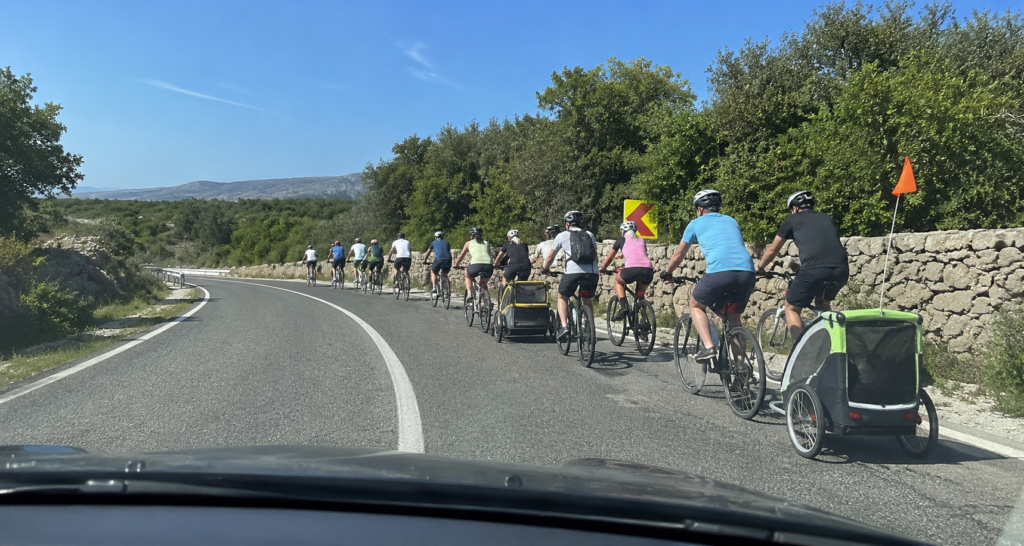
The problem is not the bicycle, but the fact that the island has pushed it onto the road
Krk has been advertised for years as an outdoor, bike and active destination. That sounds nice in tourist materials. But local people do not live on a poster. They live behind the wheel, often behind a group of cyclists on a narrow road towards Baška, Punat, Vrbnik, Šilo, Valbiska, Malinska or the town of Krk.
When slow and unpredictable traffic is added to an already overloaded island road, there is no miracle. A queue forms quickly, overtaking becomes risky, and nervousness grows minute by minute. Krk Danas has already written that the island has a serious problem with traffic and queues, and a cyclist in the wrong place at the wrong time does not ease that problem, but makes it even worse.
Where are those famous cycle paths?
In tourism communication, it is easy to talk about hundreds of kilometres of cycling routes. But residents rightly ask: are we talking about routes or actual cycle paths? One thing is a map, a sign and a GPS track along an existing road, and something entirely different is a separate cycle path built so that cyclists do not have to mix with cars, vans, buses, trucks and local traffic.
The regulations clearly distinguish between a cycle path, a cycle lane, a cycling road and a cycling route. A route can also include roads for mixed traffic, meaning roads used by both bicycles and motor vehicles. That is why it is not fair to sell every marked road to the public as cycling infrastructure.
On Krk, there are far too few proper, meaningful, separated sections. People will immediately mention the Krk bypass or the section from Donat towards Punat. And this brings us to an additional absurdity: even where a cycle path exists, some cyclists still choose the carriageway.
When a cycle path exists, the road is not a matter of choice
The law is quite clear. Cyclists are required to ride on a cycle path or cycle lane in the direction of travel, and if these do not exist, as close as possible to the right edge of the carriageway. If two or more cyclists are riding in a group, they must ride one behind the other. A fine is also prescribed for violating these rules.
In other words, riding side by side on the road, taking up a lane, cutting across intersections, stopping on the carriageway and ignoring an existing cycle path is not cycling culture. It is a traffic problem. On an island where the ambulance, delivery vehicles, workers going to work, families with children and guests waiting in traffic all use the same narrow roads, such behaviour has consequences for everyone.
E-bikes have changed the game, and that is visible on Krk
In the past, Krk’s hills did their own filtering. Anyone without enough stamina did not easily set out on longer rides across the island. Today, the situation is completely different. Legally, a bicycle may have pedals and an auxiliary electric motor of up to 0.25 kW, with the assistance gradually dropping to zero when the speed reaches 25 km/h, or earlier if the rider stops pedalling.
That has opened up Krk to an entirely new audience: pensioners, recreational riders, guests who would otherwise not dare to go over the hills, but also people who are not used to riding in traffic. The battery helps on the uphill sections, but it does not provide awareness of a blind spot, an intersection, a queue of vehicles behind you, or the rule that when riding in a group, you do not ride as if the road were closed to everyone else.
That is why the worst combination is now seen more and more often: a heavier bicycle, an insecure rider, slow reactions, riding in pairs, talking in the middle of traffic, turning without checking, and stopping where stopping should not be allowed. That is not the romance of active tourism. It is a recipe for an incident.
Krk’s roads are not a testing ground for a tourism experiment
D102 is the island’s main road, connecting the mainland, the Krk Bridge and the southern part of the island towards Baška, with a length of around 48 kilometres. It is not a quiet recreational avenue, but the traffic backbone of the island, with connections towards Omišalj, Malinska, the town of Krk, Valbiska, Punat, Vrbnik and Baška.
Alongside it are county and local roads that are often narrow, without a proper shoulder, without a protective strip, with blind bends, hills and tourist traffic that exceeds normal limits in summer. On such roads, a cyclist is not just a green addition to the tourism offer. They are the most vulnerable road user, but also a road user who can very easily slow down everyone else.
The Ordinance on Cycling Infrastructure states that on roads with speed limits above 50 km/h, cycling traffic should generally be avoided on the carriageway together with motor vehicles, unless there is a spatial limitation. That is a sentence that should be on the desk of every municipality, town, county and tourist board on Krk.
It is not enough to draw a route and say the job is done
The island of Krk cannot at the same time promote cycling tourism and pretend that it is not its problem when those same cyclists ride on roads that were not designed for them. It cannot advertise itself as a bike destination and then shift responsibility to car drivers, local people and the police.
If cyclists are invited to the island, then the island must have somewhere to put them. That means proper separated cycle paths on key sections, safe connections between places, clear signage, an end to marketing manipulation around the term “path”, better control of group riding and a clear message to guests: Krk is not a closed cycling track.
The sections towards Punat, Baška, Vrbnik, Šilo, Malinska, Valbiska and around the town of Krk need to be addressed especially, because these are not just beautiful routes for guests. They are everyday roads for islanders. Local life cannot be collateral damage of tourism that looks good on social media.
When local people ask for cycle paths, they are not asking for luxury
That is why the message “we need cycle paths” is actually very simple. This is not an ideological debate against bicycles. It is a demand that cycling tourism stop being developed at the expense of local traffic.
Islanders are not angry because someone rides a bicycle. They are angry because the same scene repeats every year: a narrow road, traffic, a cyclist or a group of cyclists on the carriageway, dangerous overtaking, nervousness and waiting. And then they are told that this is modern, sustainable and desirable tourism.
It is not sustainable when local drivers risk overtaking in order to get to work. It is not sustainable when traffic on the island is suffocated by content for which basic conditions have not been built. Nor is it sustainable when cyclists, often guests who do not know the roads, are sent into a traffic situation where their safety depends on the patience of the drivers behind them.
Conclusion
Krk does not need a war against cyclists. Krk needs to stop pretending that it has cycling infrastructure which, in reality, it does not have. Cyclists are welcome, but not in a way that turns the entire island into an improvised route where local people lose time, patience and safety every day.
If Krk wants to market itself as a cycling destination, then it must pay the price of that decision: build cycle paths, organize routes, control behaviour and clearly separate tourism promotion from the actual situation on the roads. Everything else is passing the bill on to the islanders.
Because cycling without infrastructure is not sustainable tourism. On Krk, at the moment, it is just another reason for a traffic queue.

