



The state is announcing a higher minimum lump sum tax for private accommodation providers, and on the island of Krk this topic cannot remain only a tax issue. It opens a debate about accommodation prices, the availability of housing for local people, the tourism model and the growing pressure of apartmentization.
Announced increase in the lump sum tax for private accommodation providers: what does it mean for Krk?
The announced increase in the minimum lump sum tax for private accommodation providers could become one of the most sensitive tourism topics on the coast, and therefore on the island of Krk as well. It is not hard to understand why: family accommodation on Krk is not a marginal activity, but one of the foundations of local tourism, household budgets and the seasonal economy.
But at the same time, the debate can no longer remain only at the sentence “they are attacking accommodation providers again”. For years, Krk has also been living the other side of the same story: fewer and fewer available apartments for long term rental, increasingly expensive square metres, more and more properties being bought as investments, and growing pressure for every available room to be turned into a tourist bed.
Under the current system, the lump sum income tax from renting is revenue of local self government units, and towns and municipalities determine the tax amount per bed themselves within the prescribed ranges, depending on the tourism development index. The current range for the first category is from 100 to 300 euros per bed, for the second from 70 to 200 euros, for the third from 30 to 150 euros, and for the fourth and zero category from 20 to 100 euros.
According to published announcements, from 2027 the state would raise the lower threshold of the lump sum tax: in the first group of tourism development from 100 to 150 euros per bed, and in the second group from 70 to 100 euros. This means that the greatest immediate impact would be felt precisely by those areas that are currently at the lowest permitted amounts.
In the Town of Krk, the lump sum tax is currently 100 euros per bed
For the local context, it is especially important that the Town of Krk has set the lump sum tax at 100 euros per bed for all settlements in its area. For an accommodation unit in a campsite or in a Robinson accommodation facility, the amount is 150 euros. The decision was adopted by the Town Council on 25 February 2025.
In practice, an apartment with four basic beds in the Town of Krk currently pays 400 euros per year on this basis. If the new minimum of 150 euros per bed were applied, the same apartment would pay at least 600 euros per year for the lump sum tax alone. This is not the accommodation provider’s total annual cost, because in addition to this there are the tourist tax, tourist board membership fee, real estate tax, utilities, maintenance, cleaning, platform commissions and increasingly expensive labour.
That is why reactions will be strong. For someone who has one apartment and supplements the household budget seasonally, an increase in the lump sum tax is not the same as for the owner of a larger number of apartments, holiday homes or investment properties. The problem is that the lump sum tax per bed does not distinguish these situations well enough. Two beds in an old family house and a serious apartment business are not the same story, but the system often places them in the same framework.
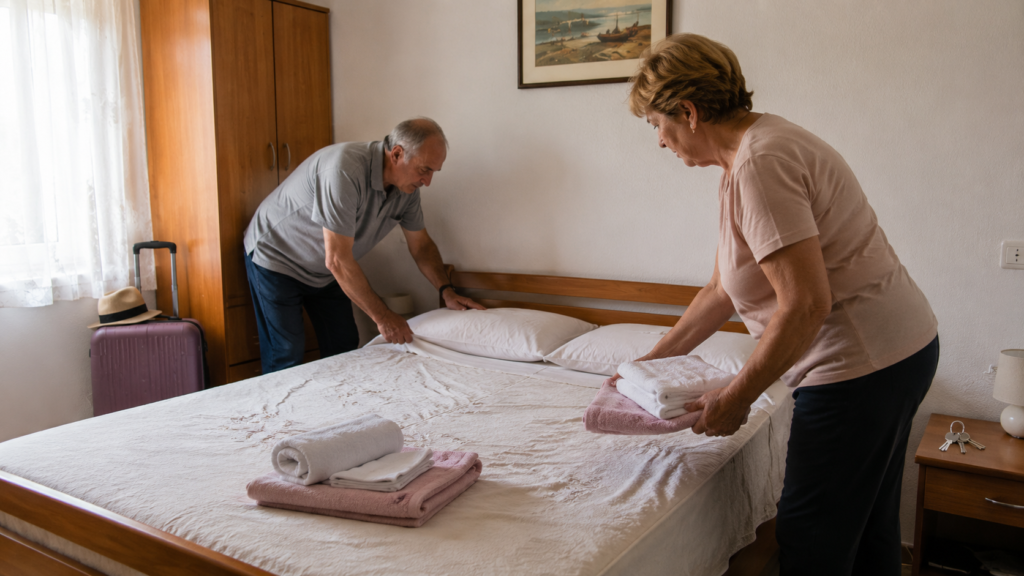
Accommodation providers will try to pass part of the cost on to guests
The most realistic scenario is that some accommodation providers will try to pass the higher cost on to the accommodation price. This means a more expensive apartment, especially in the main season, because that is when it is easiest to “catch” the difference. But this creates another problem: if prices are raised further, Krk does not automatically become a better destination, but a more expensive one.
In the pre season and post season, the effect may be even more unpleasant. A higher fixed cost may push some accommodation providers to focus even more on July and August, instead of lowering prices and filling accommodation outside the peak season. This could result in a measure presented as part of a broader effort to regulate the market actually shortening the season further, instead of extending it.
On the other hand, it is not realistic to claim that the current model has been without problems. Tourism on Krk has long been about more than just guests and overnight stays. It is about who can live on the island, where young families will find housing, whether workers can even come to work the season, and how much the local community receives from space that is being used commercially.
Not all renting is the same, but “every hole for rent” is not a sustainable model either
In the debate, the argument that family accommodation should be protected will certainly be heard. And it should be protected, especially when we are talking about local people who live on the island and rent out part of their own house. For decades, this has been part of tourism on Krk and has enabled many families to survive, invest in their homes and remain on the island.
But it is equally necessary to say what is often left unsaid: a model in which almost every property is turned into short term rental is destructive for the local community in the long run. If apartments are no longer built and bought for living, but exclusively for tourism income, then the result is not only higher taxes, but also empty places in winter, a lack of long term rental and square metre prices that become unreachable for local people.
This is the real dilemma for Krk. The question is not whether accommodation providers should be “punished”. The question is what kind of tourism the island wants and can sustain.

Perhaps a fairer model would be VAT on turnover, not constant increases in the lump sum tax
One possible direction, however unpopular it may be among some accommodation providers, would be to introduce clearer taxation based on actual turnover. For example, a model in which private accommodation providers would also move closer to the rules that apply to business entities in tourism through a 13 percent VAT on turnover, with the right to deduct input VAT for actual investments, equipment and maintenance, would be economically cleaner than simply increasing the lump sum tax per bed. The Tax Administration states that the VAT system includes rates of 0, 5, 13 and 25 percent.
Such a model would have at least one logic: those who generate higher turnover pay more; those who invest in quality, renovation and legal business operations have the possibility to use input VAT; those who operate on a small scale would not be burdened by the same model as someone who earns serious income from tourism. This would not be easy to implement and would certainly cause resistance, but it would open a fairer debate than the current one, in which the lump sum threshold is simply moved every year, while actual turnover remains in the background.
Krk needs a serious local debate, not a shouting match
This topic on Krk should not end in two extremes. The first is that all private accommodation providers are the problem. The second is that the system must not be touched because “it has always been like that”. Neither is true.
Krk needs to distinguish between local family accommodation and the apartment business. It needs a tax model that does not push small accommodation providers into giving up, but also does not encourage the endless conversion of residential space into a tourism product. It also needs a clear calculation: how much the local community gains, how much it loses through the lack of housing, how much is truly invested in quality, and how much simply relies on high demand.
If this is not done, the increase in the lump sum tax will be just another cost that will be passed on to guests or cause a revolt among accommodation providers. And the key problem, the pressure of short term rental on life on the island, will remain the same.
The debate is only beginning. And on Krk, it will certainly be loud.

